REWIND
Walkman vs MP3 player: what is the difference?
A Walkman is a portable cassette player, launched by Sony in 1979, that plays analog tape. An MP3 player stores compressed digital files in memory. A C90 tape holds about 45 minutes a side and is slow to skip around, while an MP3 player jumps to any song instantly.
Download free on iPhoneSee all 30 machines
8 machines free forever · no account · works offline
What is the main difference?
The medium. A Walkman reads a magnetic signal from a cassette tape that runs past a head. An MP3 player reads digital files, stored in flash memory or on a small hard drive, and decodes them into sound. One is analog and mechanical, the other digital and electronic.
Walkman is also a brand. Sony launched the TPS-L2 on 1 July 1979. It ended cassette Walkman production in 2010, and since 2011 the name has covered only digital flash players (Wikipedia: Walkman). In everyday speech, people say walkman for any pocket tape player.
How do they compare side by side?
| Cassette Walkman | Early MP3 player | |
|---|---|---|
| Year | 1979 for the first Walkman | 1998 for the first mass-market flash players |
| Storage | C60 holds 30 min per side, C90 holds 45 | Early Rio PMP300: 32 MB of memory, tens of minutes of music |
| Format | Analog magnetic tape | Compressed MP3 files |
| Finding a song | Wind and guess, or use a search function | Instant, by track number |
| Order of songs | Fixed by the recording | Shuffle, playlists, repeat |
| Power | Batteries, often two AA | One AA battery in the Rio PMP300, 8 to 12 hours |
| Skipping when bumped | Rarely, tape keeps going | None, solid state |
| Sound character | Hiss, wow and flutter, warmth | Clean, but compression artifacts at low bitrates |
| Media cost | Cassettes, blank or pre-recorded | Files you already own |
| Repair | Belts, heads, rollers wear | Memory and batteries fail |
How much music could each hold?
A C90 cassette holds 90 minutes, which is about 20 songs. The Rio PMP300, which launched in 1998, shipped with 32 MB of memory and a SmartMedia slot for more (Wikipedia: Rio PMP300). At a typical 128 kbit/s MP3 rate, 32 MB is about half an hour. So at first, the cassette held more music than the player that replaced it. Capacity swung the other way within a few years, as flash chips and 1.8-inch hard drives grew. The hard-drive iPod announced in October 2001 held 5 GB, which is about 1,000 songs.
Pocket players of both types changed the way people listened. The tape needed physical swaps. The MP3 player turned a whole library into a set of files.
How do they sound?
A cassette has a limited frequency range, a steady noise floor of hiss and small speed variations, which are explained in wow and flutter. Chrome and metal tapes improve high frequencies, as covered in cassette tape types. Many listeners enjoy the saturation of tape, covered in what is tape saturation.
An MP3 player is quieter and steadier. How it sounds depends on the file bitrate and the player's headphone amplifier. Low bitrates of the late 1990s had audible artifacts such as smeared cymbals. At 192 kbit/s or higher, many listeners cannot tell it from a CD in casual listening.
What are the practical pros and cons?
- Walkman pros: simple, mechanical, cheap tapes, a physical object that you can give away.
- Walkman cons: tapes degrade and tangle, you cannot jump to a song, each side has a fixed length, and you wind to find a track.
- MP3 player pros: instant song selection, shuffle, light weight, no moving parts in flash models.
- MP3 player cons: needs a computer to load files, early models held little, small screens, no physical media to keep.
What about the CD Walkman and the MiniDisc?
Between the cassette and the MP3 player came two other pocket formats. The portable CD player appeared in 1984 as the Discman, held about 74 to 80 minutes on a disc, and sounded cleaner than cassette, but it skipped when jolted, which led to anti-skip memory. See anti-skip CD players explained.
Sony announced the MiniDisc in September 1992 and released it that November, using ATRAC compression on a small disc as a portable recordable format (Wikipedia: MiniDisc). It was popular in Japan and had a following elsewhere, but MP3 players overtook it. The line from tape to CD to MiniDisc to files shows steady growth in capacity and a decline in moving parts.
Each step also changed the habit. Tapes made people record and swap mixes, CDs made them buy albums, and files made them carry whole libraries, so the choice of player shaped how music was shared as well as how it sounded.
Which one fits you now?
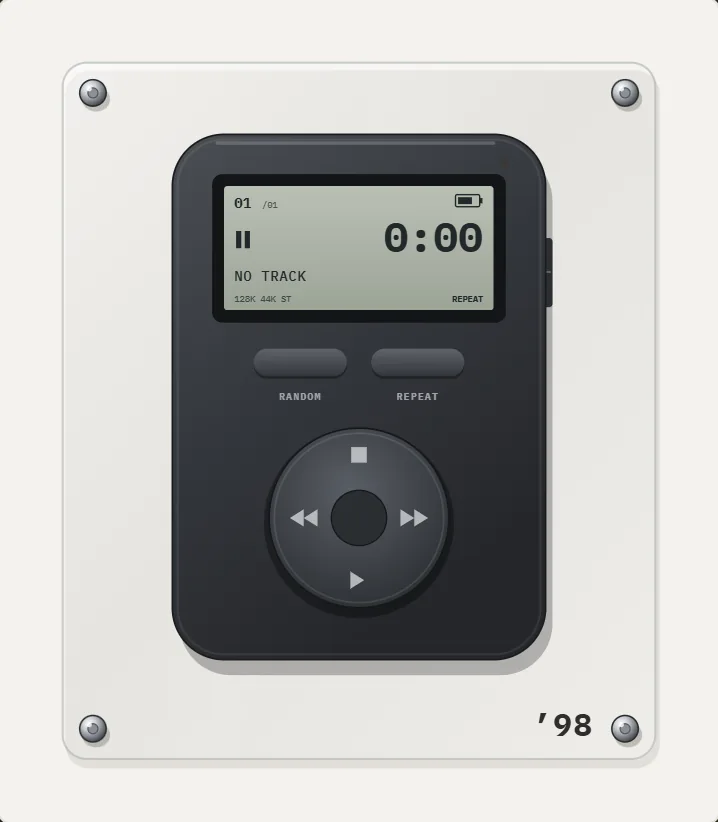
If you want a hobby and a ritual, a working cassette player and a few tapes give you that. If you want to carry a lot of music, a phone or a modern digital player does the job. A middle path is to keep your files on your iPhone and play them in a player that feels like the old hardware. REWIND has 10 pocket cassette machines and a 1998 flash MP3 player for your own files. Both play audio files you import from the Files app, so no tape is involved. The history of each is in the compact cassette and the MP3 player.
Frequently asked questions
Is a Walkman an MP3 player?
Not originally. The Walkman began as a cassette player in 1979. Since 2011 the Walkman name belongs to Sony's digital players, which play files.
What is the difference between a Walkman and an iPod?
A Walkman plays tape (or, later, digital files), and an iPod plays digital files from a hard drive or flash. The iPod launched in October 2001 and held about 1,000 songs.
Did MP3 players replace Walkmans?
Largely, yes, over the late 1990s and 2000s. Portable CD players came first, and MP3 players and then smartphones followed.
Which has better sound, cassette or MP3?
An MP3 at a good bitrate is cleaner. Cassette has more noise, but many people prefer its warm character.
Can I get the Walkman look on an iPhone?
Yes, in a player app. REWIND shows pocket cassette machines that play your own files. It does not play real tapes or record.
Keep exploring
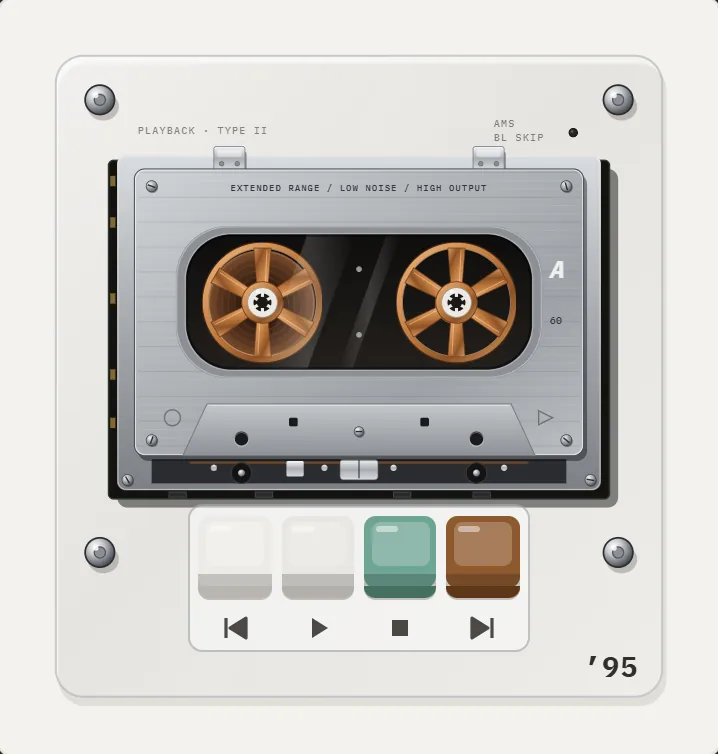 Cassette players10 pocket cassette machines with turning reels, swipe-to-wind and tape stop.
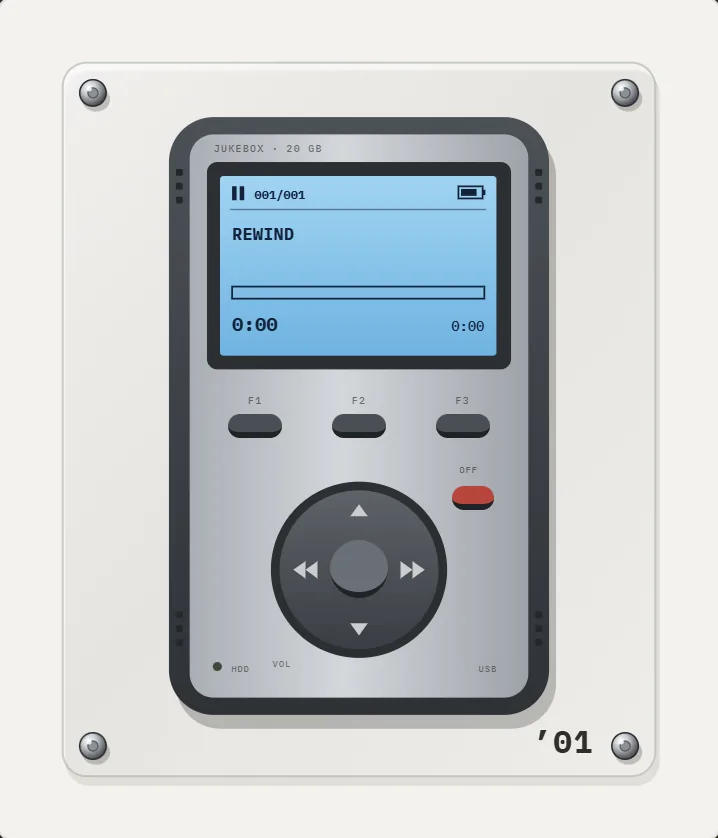 MP3 players2 early MP3 players: a 1998 flash stick and a 2001 hard-drive brick.1998 Flash MP3 Player App for iPhoneMatte graphite body, gray monochrome LCD, RANDOM and REPEAT keys, round cross pad. A PRO ’98 MP3 player.History of the MP3 PlayerFrom the MPMan F10 and Rio PMP300 in 1998 to the 2001 iPod and the smartphone: a dated history of the MP3 player.History of the Compact CassetteFrom a pocket-sized dictation tape in 1963 to the Walkman era and the modern revival: the dated history of the Compact Cassette.
 Can You Still Buy a Discman or Walkman in 2026?What Sony still sells, where to find working cassette and CD players, what to inspect, and the cheapest way to get the feel on a phone.