REWIND
The history of the MP3 player, 1998 to the smartphone
A digital audio player stores compressed music files, most often MP3, in flash memory or on a small hard drive. The first mass-produced one, the MPMan F10, went on sale in Asia in March 1998 and held about six songs. Apple's iPod arrived in 2001 and turned the category into a mainstream product.
Download free on iPhoneSee all 30 machines
8 machines free forever · no account · works offline
Where did the MP3 format come from?
MP3 (formally MPEG-1 Audio Layer III) was developed largely at the Fraunhofer Society in Germany under Karlheinz Brandenburg. It was approved as an ISO standard draft in 1991, finalized in 1992 and published in 1993 as ISO/IEC 11172-3. The MP3 article tracks the details.
Three dates mattered for ordinary users. Fraunhofer released the first software encoder, l3enc, on 7 July 1994. The team chose the .mp3 file extension on 14 July 1995. The first real-time software player, WinPlay3, followed on 9 September 1995. From then on, anyone with a PC could turn a CD into small files.
The saving was large. A CD stores 1,411 kbit/s of stereo audio (44,100 samples a second x 16 bits x 2 channels). At 128 kbit/s, a common MP3 setting, the file is about 11 times smaller. One minute of 128 kbit/s audio is just under 1 MB, which is what made a chip with a few dozen megabytes of memory worth building.
What was the first MP3 player?
The MPMan F10, made by South Korea's SaeHan Information Systems, went on sale in Asia in March 1998. It measured 90 x 70 x 16.5 mm, weighed a little over 65 grams and held 32 MB in the basic model. You loaded songs from a PC through a parallel-port docking station, as the MPMan article describes. In the United States it was sold as the Eiger MPMan F10 for roughly 200 to 250 dollars.
A few months later, in September 1998, Diamond Multimedia launched the Rio PMP300, also with 32 MB, and became the first commercially successful player. Even earlier, Audio Highway's Listen Up Player (1996) existed, but only 25 units were made. At 128 kbit/s, 32 MB meant roughly six to eight songs, so early owners swapped files constantly.
Did the record industry try to stop it?
It tried. The RIAA sued Diamond in late 1998, arguing the Rio encouraged illegal copying. Diamond won by leaning on the 1984 Sony v. Universal ruling, the Betamax case, and portable players were treated as ordinary electronics. The legal green light helped investment pour into the category, and other makers soon joined, including Creative Labs with the Nomad and RCA with the Lyra.
Most of those early devices still used slow parallel-port transfers. The MP3 player article has the full list.
How did hard drives and the iPod change things?
Flash memory was expensive, so makers experimented with small hard drives. Apple unveiled the iPod on 23 October 2001. It had a 1.8 inch, 5 GB drive, a 2 inch monochrome display, and the slogan 1,000 songs in your pocket. It went on sale on 10 November 2001. The first model worked only with Macs. A Windows-compatible version followed in July 2002, and the iPod article notes that Apple announced its hundred-millionth unit sold on 9 April 2007.
South Korean makers like iRiver, Mpio and Cowon held as much as 40% of the world market at their peak, then lost ground after 2004 and were overtaken by Samsung by 2006. Apple has sold an estimated 450 million iPods in all. Apple discontinued the line on 10 May 2022.
| Year | Event |
|---|---|
| 1993 | MPEG-1 Audio (with Layer III) published as ISO/IEC 11172-3 |
| 1995 | .mp3 extension chosen; WinPlay3 plays MP3 in real time on a PC |
| 1998 | MPMan F10 (spring, Korea); Rio PMP300 (September, US) |
| 1999 | Creative Nomad, RCA Lyra and others join the market |
| 2001 | iPod unveiled on 23 October, sold from 10 November |
| 2006 | Samsung overtakes the South Korean startups |
| 2007 | iPod touch; 100 millionth iPod sold |
| 2010 | iPhone sales overtake iPod sales |
| 2022 | Apple discontinues the iPod line |
Why did early MP3 players look the way they did?
Because the screen was tiny and the song list was long. First-generation flash players used one or two lines of monochrome LCD, a handful of buttons and a headphone jack. Hard-drive players added a jog dial or scroll wheel so you could rush through hundreds of titles. The iPod popularized the scroll wheel, and many makers copied the idea.
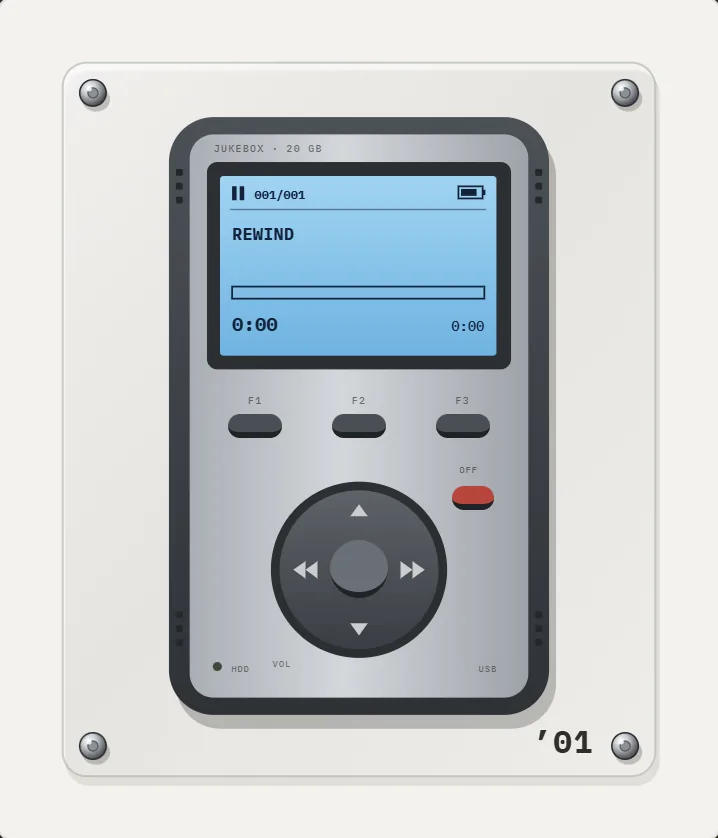
That design language is the reason these players still look good. Rubber bumpers, a monochrome backlit screen and a small steering pad feel like a gadget from the turn of the millennium. The 2001 hard-drive machine in REWIND has exactly that. We described the MP3 mechanics from a player's point of view in MP3 players.
What ended the dedicated MP3 player?
The phone. By 2008 video-capable players were outselling audio-only ones, and in the middle of 2010 iPhone sales overtook iPod sales. Today every smartphone is a portable media player.
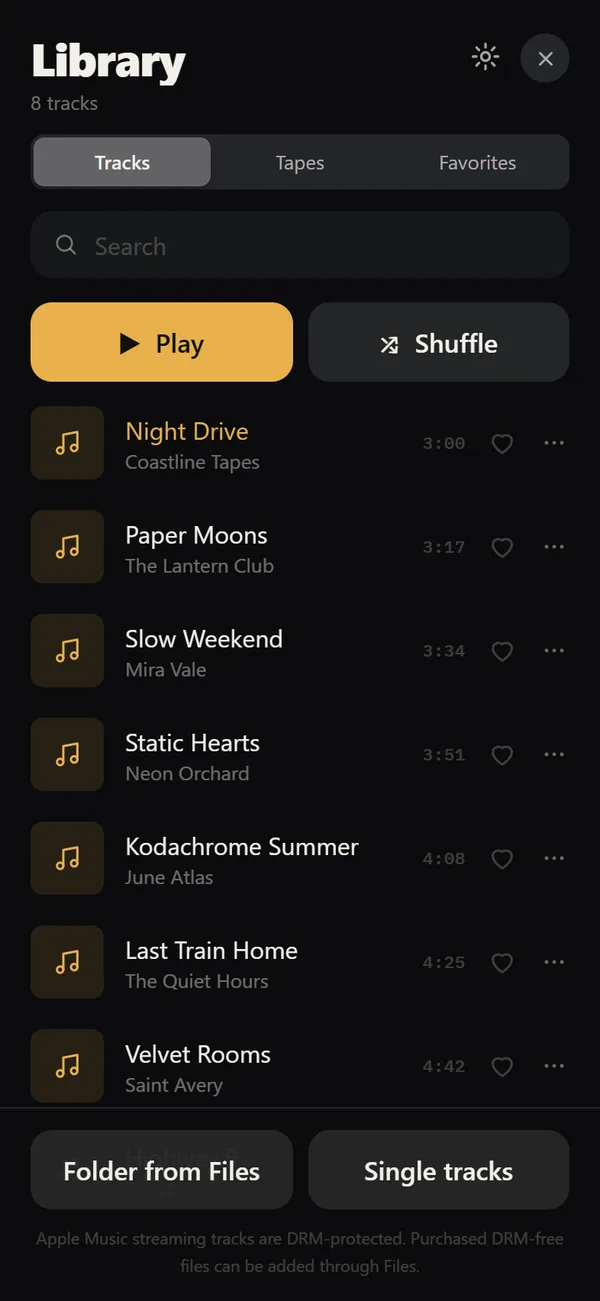
A phone also changed the source of the music. Where the first buyers ripped CDs, today's listeners stream, and streaming tracks are locked to the service. If you want to keep files you own, our guides on DRM-free music stores and on Apple Music songs that will not import explain what works.
Can you still use an MP3 player on your iPhone?
In a way, yes. REWIND shows your own music files on 2 early digital players drawn from 1998 and 2001: the flash machine and the hard-drive brick with a joystick pad. Drag a finger along the player to scrub, and the screen shows title, artist, progress and time. Try dig-flash98 or dig-wheel01, and see the MP3 format guide for the file side.
Frequently asked questions
What was the first MP3 player?
The MPMan F10 from South Korea's SaeHan went on sale in Asia in March 1998. It held 32 MB, enough for about six to eight songs.
Who invented MP3?
MP3 was developed mainly at Germany's Fraunhofer Society under Karlheinz Brandenburg, as part of the MPEG-1 standard published in 1993.
When did the iPod come out?
Apple unveiled the first iPod on 23 October 2001 and started selling it on 10 November 2001. It had a 5 GB hard drive.
Why did the RIAA sue over the Rio?
The RIAA argued in late 1998 that the Rio PMP300 encouraged illegal copying. Diamond won, and portable digital players were treated as ordinary electronic devices.
Can I play MP3 files on a retro-style player on my iPhone?
Yes. REWIND plays MP3 and several other file types from the Files app, offline, on drawn early digital players that scrub with a wheel.
Keep exploring
MP3 players2 early MP3 players: a 1998 flash stick and a 2001 hard-drive brick.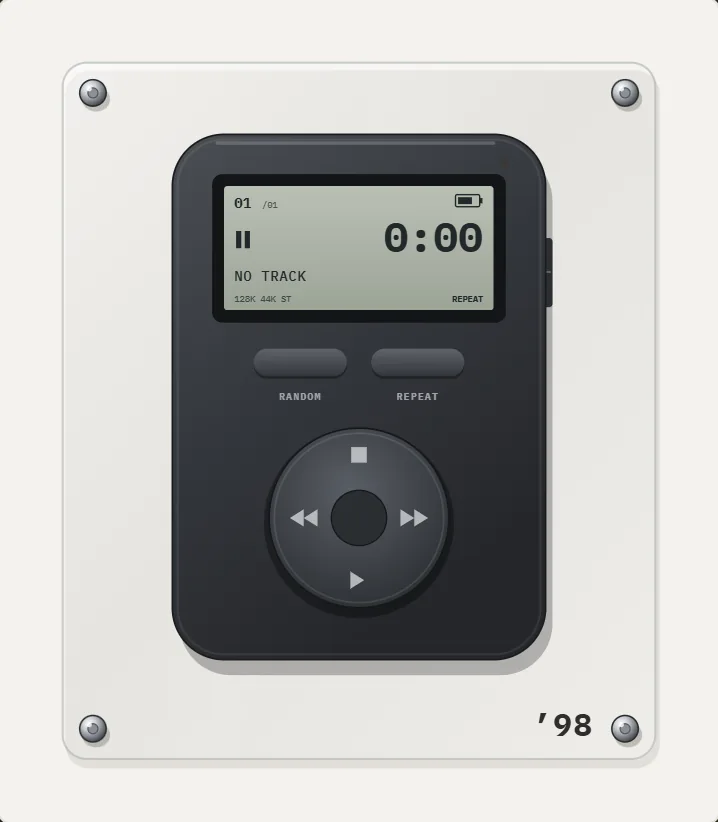 MP3 on iPhoneThe classic lossy format. Bitrates, sizes, how to load it on iPhone, and how REWIND plays it.Retro MP3 Player App for iPhoneWhy the first MP3 players looked the way they did, and how a retro MP3 player app for iPhone recreates two of them.
 Where to Buy DRM-Free MusicWhere to get music as files you own: Bandcamp, iTunes, Qobuz, Amazon, Beatport and CD rips, plus how to check a file is DRM-free.2001 Hard-Drive Brick MP3 Player AppSilver brick in rubber bumpers, blue-backlit LCD, F1–F3 keys, round joystick, red OFF key. PRO.