REWIND
The history of the Compact Cassette, from dictation tape to Walkman
The Compact Cassette is a two-reel magnetic tape cartridge that Philips introduced on 28 August 1963 at the Berlin Radio Show. A Dutch engineer, Lou Ottens, led the team. It started as a dictation format, became the most popular way to buy new music in the United States from 1983 to 1991, and survives today as a small, stubborn niche.
Download free on iPhoneSee all 30 machines
8 machines free forever · no account · works offline
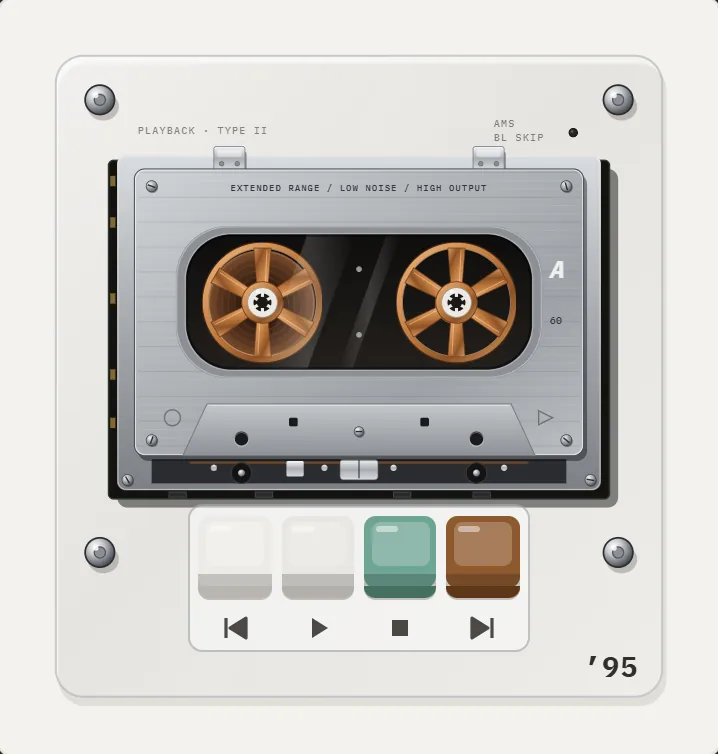
Spin the reels with your finger · press ▶ ■
What exactly is the Compact Cassette?
The Compact Cassette, also called the audio cassette or simply tape, is an analog magnetic tape format. Two small spools sit inside a plastic shell, and the tape winds from one to the other past a playback head. Each side carries one stereo pair of tracks, so flipping the cassette plays the second pair.
The numbers below come from the Wikipedia article on the Compact Cassette, which cites the original Philips specification.
| Spec | Value |
|---|---|
| Introduced | 28 August 1963, Berlin Radio Show (Philips) |
| Lead engineer | Lou Ottens, Philips Hasselt, Belgium |
| Tape width | 3.81 mm (0.15 in) |
| Tape speed | 4.7625 cm/s (1 7/8 inches per second) |
| Shell size | 10.2 x 6.35 x 1.27 cm at its largest |
| Tracks | Four, as two stereo pairs (one per direction) |
| Common length | C60: 30 minutes per side; C90: 45 minutes per side |
Who invented the cassette, and why is it so small?
Lou Ottens (1926 to 2021) ran product development at the Philips factory in Hasselt. According to his Wikipedia biography, he started the design by cutting a block of wood to fit his jacket pocket. That block set the size of the cassette, and his team of ten or twelve people built a tape mechanism to match it.
Philips showed the system in Berlin in August 1963 and sold it in the United States under the Norelco name from November 1964. A rival was in the field too. Grundig launched the DC-International cassette in 1965, and the two companies were competing to set the world standard.
Philips settled the fight by giving the format away. It licensed the Compact Cassette freely from 1966, partly under pressure from Sony, and Grundig's format was discontinued in 1967. A free license meant every Japanese manufacturer could build a cassette machine without paying a toll, and that is how a Dutch dictation gadget turned into a global standard.
How did a dictation tape become a hi-fi format?
Early cassettes sounded thin and hissy. The tape ran at under 5 cm/s, so the signal was squeezed into a narrow strip and the noise floor was high. Four developments pushed the cassette toward music.
Dolby B noise reduction, 1968. It lifted quiet high-frequency passages during recording and lowered them again on playback, cutting audible hiss by about 9 dB, according to the Dolby noise-reduction overview.
Chromium dioxide tape, 1970. DuPont began commercial production of CrO2 media in 1968, and Advent sold the first CrO2 cassette in 1970. In 1971 Advent's Model 201 deck paired Dolby B with chrome tape and made serious listeners take the format seriously. If you want the full story of tape grades, see normal, chrome and metal cassette types.
Metal tape, 1979. 3M's Metafine was the first Type IV tape made from pure metal particles.
The four-track Portastudio, 1979. The TEAC 144 let a musician overdub parts at home on four tracks.
How big did the cassette get in the 1980s?
Very big. Sony's TPS-L2 Walkman went on sale on 1 July 1979, and for the first time a person could listen privately while walking. Sony sold roughly 220 million cassette-based Walkman units before ending production in 2010, per the Walkman article.
From 1983 to 1991 the cassette was the most popular format for new music sales in the United States. The RIAA sales database tracks the shipment history, and US pre-recorded cassette sales peaked around 442 million units in 1990. Car stereos, boomboxes and home decks all spoke cassette, and the blank tape became the first format ordinary people could copy onto: the mixtape.
If you want a closer look at the hardware of that decade, the home cassette deck and the boombox are the two machines that did the heavy lifting, while the pocket player is covered on the cassette player page.
What replaced the cassette?
The compact disc did. By 1991 the CD had passed vinyl and cassette in US sales, and by 2000 it held 92.3% of the US market, according to the Compact Disc article. Philips tried a digital successor to its own tape, the Digital Compact Cassette, in 1992. It failed and was discontinued in 1996.
US pre-recorded cassette sales fell from 442 million in 1990 to 274,000 by 2007. The 2011 model year was the first with no American manufacturer offering a factory-installed cassette player. The portable CD player and later the MP3 player took over the pocket.
A timeline of the Compact Cassette
| Year | Event |
|---|---|
| 1963 | Philips introduces the Compact Cassette in Berlin |
| 1964 | US launch under the Norelco brand |
| 1966 | Philips licenses the format freely; US recorder sales pass 250,000 |
| 1968 | Dolby B introduced |
| 1970 | First chromium dioxide cassette |
| 1979 | Walkman TPS-L2 (1 July), metal tape, TEAC Portastudio |
| 1983 | Cassette becomes the top format for new music sales in the US |
| 1990 | US pre-recorded cassette sales peak near 442 million |
| 1992 to 1996 | Digital Compact Cassette launched and discontinued |
| 2010 | Sony ends cassette Walkman production |
| 2016 | US cassette sales rise 74% to 129,000 units |
Is the cassette still around?
It is, in small numbers. US sales rose by 74% in 2016 to about 129,000 units, and UK cassette sales in 2021 were the highest since 2003, as the Compact Cassette article summarizes. In Japan, Maxell was still selling about 8 million tapes a year in 2021. The reasons people cite are low cost, tradition, and a fondness for the way tape rounds off the edges of a recording. We dig into that revival in why cassettes are back.
REWIND is built around that affection. It draws 10 pocket cassette machines on your iPhone, with reels that turn while a song plays, a swipe to wind and rewind, and a pause that does a real tape stop. The music is your own files, played offline. Start with the cassette player page or the 1995 tape95 machine.
Frequently asked questions
Who invented the cassette tape?
Lou Ottens and his team at Philips in Hasselt, Belgium, developed the Compact Cassette. Philips introduced it on 28 August 1963 at the Berlin Radio Show.
When was the first Walkman released?
Sony's TPS-L2, the first Walkman, went on sale in Japan on 1 July 1979. It played Compact Cassettes through headphones.
How long is a C60 cassette?
A C60 holds 60 minutes in total, 30 minutes on each side. C90 tapes hold 45 minutes per side, and C120 tapes hold 60 minutes per side.
Why did the cassette lose to the CD?
CDs offered cleaner sound, no tape hiss, and instant track skipping. By 1991 the CD had overtaken cassette and vinyl in US sales.
Can I play cassette-style music on my iPhone?
Yes. REWIND is an iPhone app that plays your own audio files on drawn retro machines, including pocket cassette players, decks and boomboxes, entirely offline.
Keep exploring
Cassette players10 pocket cassette machines with turning reels, swipe-to-wind and tape stop.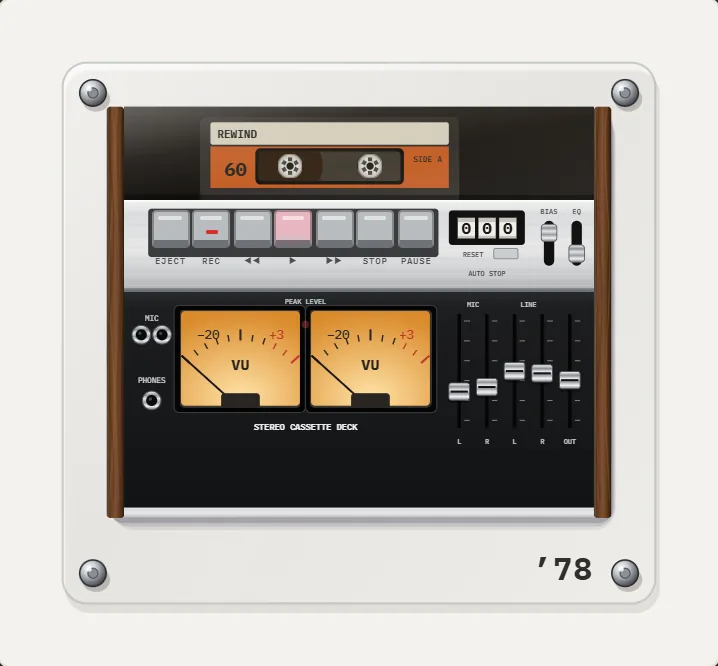 Cassette decksA 1978 walnut-sided cassette deck with piano keys, counter and two amber VU meters.Tactile Retro ControlsSwipe to wind, finger to scratch, buttons that click, a real tape stop. Sounds are synthesized on device.
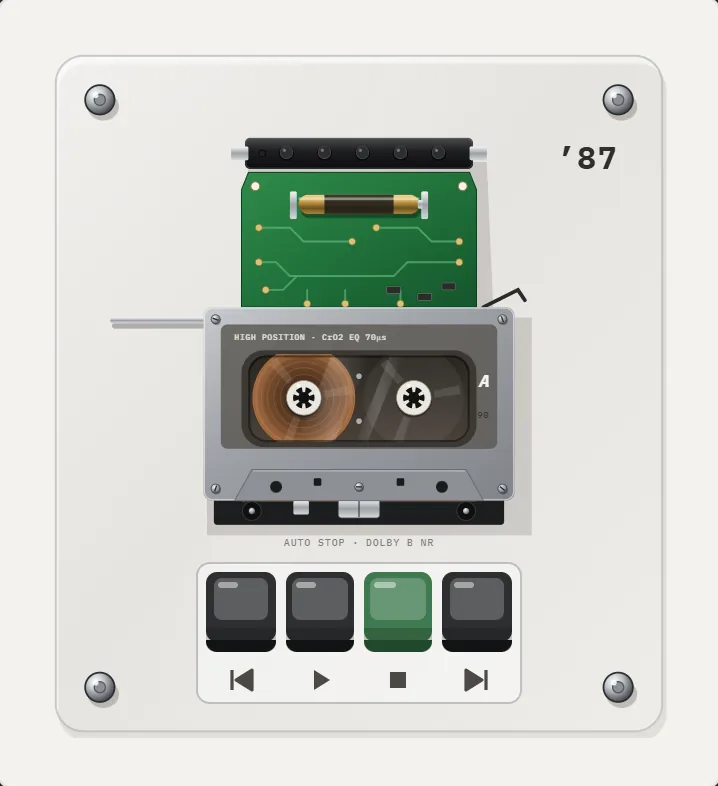 Why Cassettes Are BackReal numbers on the cassette revival: US and UK sales, who still makes tape, why people buy it, and what it cannot do.
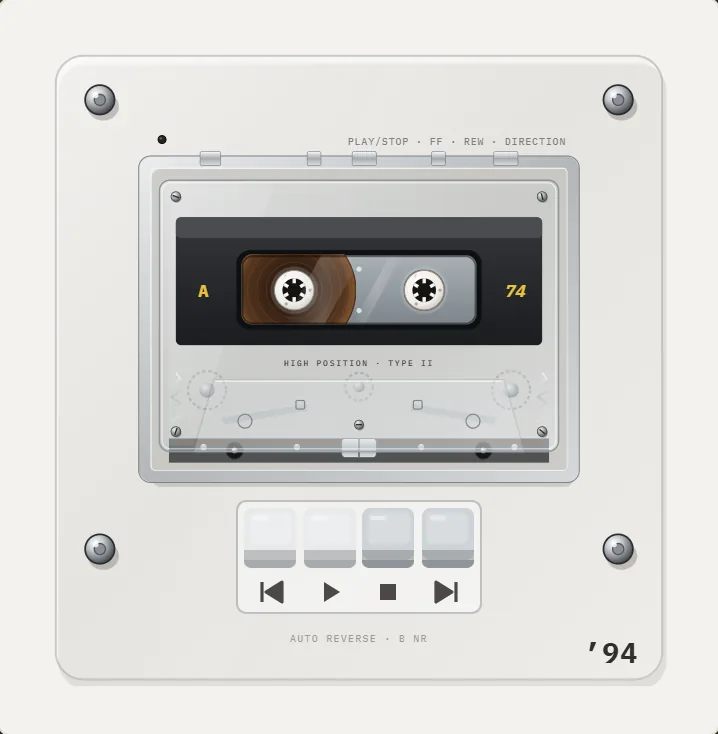 Cassette Tape TypesNormal, chrome and metal cassettes compared: coatings, bias, equalization, notches and what to use today.1995 Cassette Player for iPhoneSilver chassis, copper six-spoke reels, brown tape pack. The default machine, free for everyone.