REWIND
The history of the portable CD player
A portable CD player is a battery-powered disc player with a headphone jack. Sony launched the first one, the D-50 (D-5 in some regions), in November 1984 for 49,800 yen, about US$350. It carried the compact disc out of the living room, and it stayed in pockets until MP3 players and phones replaced it.
Download free on iPhoneSee all 30 machines
8 machines free forever · no account · works offline
Where did the compact disc come from?
Philips and Sony each built digital audio disc prototypes in the late 1970s, and in 1979 they formed a joint task force. The result was the Red Book standard: two channels of 16-bit audio sampled at 44.1 kHz on a 120 mm disc. The first commercial CD was pressed on 17 August 1982 in Langenhagen, Germany. It held Claudio Arrau playing Chopin waltzes. Japan got CDs and players in October 1982, and Europe and North America followed in March 1983.
A popular story says the disc holds 74 minutes so that Beethoven's Ninth Symphony fits. Philips engineer Kees Immink has called that a myth, as the Compact Disc article explains. What is certain is the format: a disc spins at constant linear speed, from roughly 500 rpm near the centre to roughly 200 rpm at the rim.
What was the first portable CD player?
The Sony D-50 (called D-5 in some regions) went on sale in November 1984. Sony engineers had run a cost-down effort they nicknamed the CD CD Project, for Compact Disc Cost Down. By August 1983, according to Wikipedia, they could build a player one-tenth the size of the 1982 CDP-101, and the target size was a stack of four CD jewel cases.
The D-50 shipped without a battery pack. It took power from a 9-volt adapter or a carrying sleeve that held six C cells. At 49,800 yen it cost about half as much as the CDP-101, and it sparked public interest in CDs. The details are in the Discman article. Early units were sold as the CD Compact Player. The Discman name came later, borrowed from the cassette Walkman, and Sony renamed the line CD Walkman between 1997 and 2000.
Why did early portable CD players skip?
A laser reads pits about 500 nm wide on a spiral track. Any jolt can push the laser off the track for a moment, and the audio drops out. Walk, jog or ride in a car with a 1980s portable and you heard it.
The first fix was physical. Makers hung the mechanism on rubber shock absorbers, which made the players bulky. Around 1995 a second fix appeared, electronic skip protection, which we cover in detail in how anti-skip CD players work. The short version: the player reads ahead into a memory chip and plays from that buffer while the laser finds its place again. The first buffers held about 3 seconds.
Timeline of the portable CD player
| Year | Milestone |
|---|---|
| 1979 | Sony and Philips set up a joint CD task force |
| 1982 | First CD pressed (17 August); CDs launch in Japan in October |
| 1983 | CD launches in Europe and North America (March) |
| 1984 | Sony D-50 / D-5 portable player (November) |
| 1991 | CD overtakes vinyl and cassette in US sales |
| c. 1995 | Electronic skip protection (3-second buffers) appears |
| 1997 to 2000 | Sony renames Discman to CD Walkman |
| 1998 | Flash MP3 players arrive (MPMan F10, Rio PMP300) |
| 2000 | CDs hold 92.3% of the US music market |
| 2003 | ATRAC CD Walkman D-NE1 plays MP3 and ATRAC discs |
| Early 2010s | Discman and CD Walkman lines discontinued |
What did the 1990s add?
Mostly bigger buffers and smarter batteries. The Wikipedia article on skip protection notes that players made from 1992 to 1997 could lose up to half their battery life when the buffer was on, and that models from 1997 onward used more efficient circuits. By 2006 buffers ranged from 10 seconds to effectively skip-free.
Trade names such as ESP, Anti-Shock, Joggable and G-Protection all described the same buffer idea. For the playback side of the story, see our CD player page.
How did MP3 end the portable CD era?
Flash players had no moving parts, so they never skipped. The Rio PMP300 arrived in September 1998 with 32 MB of storage, and the Rio line is credited with starting the shift away from portable CD players, as covered in our history of the MP3 player. Apple's iPod then became the dominant seller of portable players within about ten years, while Sony struggled.
The CD itself adapted for a while. Sony's ATRAC CD Walkman line played compressed data discs as well, and most models also read MP3 files. But a disc is a disc: it needs a drive, a laser, and a spinning motor. A phone needs none of them.
Where can you still feel a portable CD player?
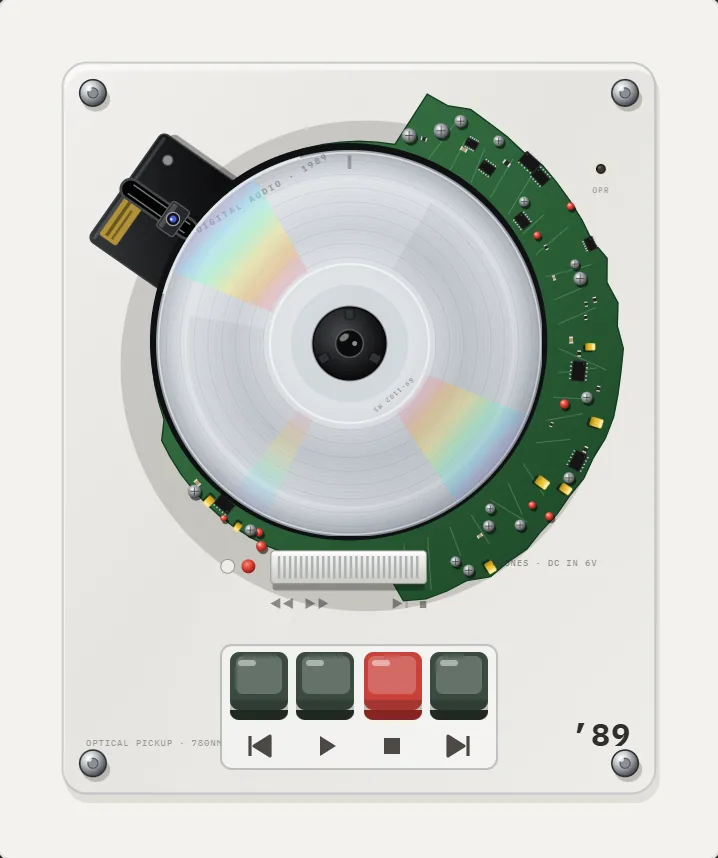
On an iPhone, in REWIND. The app draws 11 opened-up portable CD players, from 1989 to 2005, and the music is your own files, played offline from the phone. You can put a finger on the disc and scratch, and the buttons click down. Try the 1989 disc-d350, the 1993 disc93 (a free machine) or the 2000 disc-ct430. The disc is drawn, and the song is a file on your phone.
Frequently asked questions
What was the first portable CD player?
The Sony D-50, called the D-5 in some regions, launched in November 1984 and cost 49,800 yen. The Discman brand name was added soon after.
What is a Discman?
Discman was Sony's brand name for portable CD players from the mid-1980s. Sony changed it to CD Walkman between 1997 and 2000.
Why did Discmans skip when you walked?
A jolt can push the laser lens off the narrow data track. Rubber shock absorbers helped, and from about 1995 memory buffers kept the music playing while the laser recovered.
How long is a standard CD?
A standard 120 mm CD holds up to 74 minutes of audio, extended to 80 minutes on many discs. It stores 16-bit stereo audio at 44.1 kHz.
Is there a portable CD player app for iPhone?
REWIND shows your own audio files on drawn portable CD players from 1989 to 2005. It does not read physical discs. It plays files from the Files app, offline.
Keep exploring
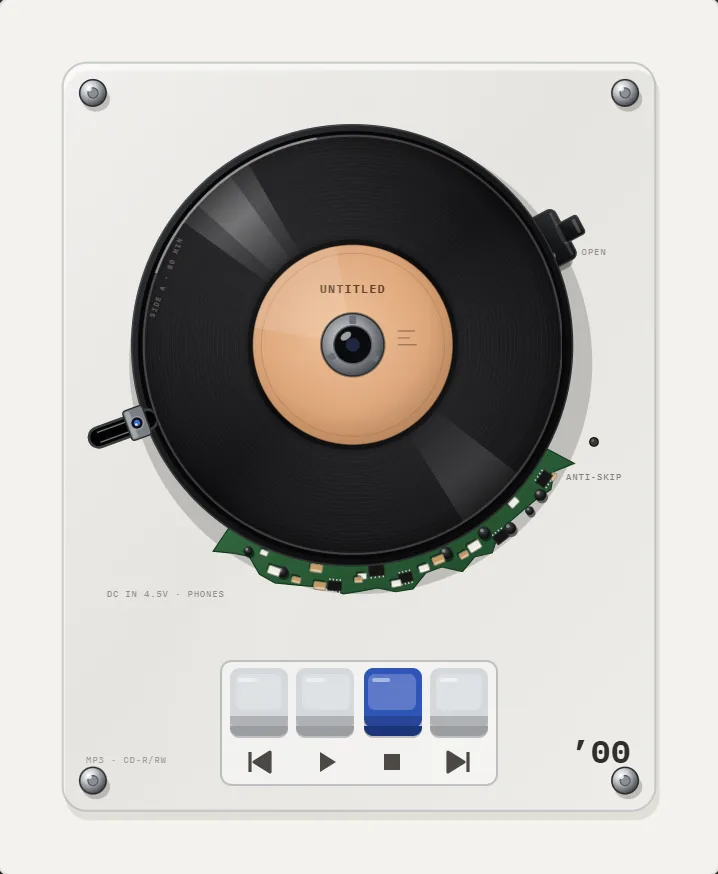 CD players11 opened portable CD players from 1989 to 2005 with scratching.
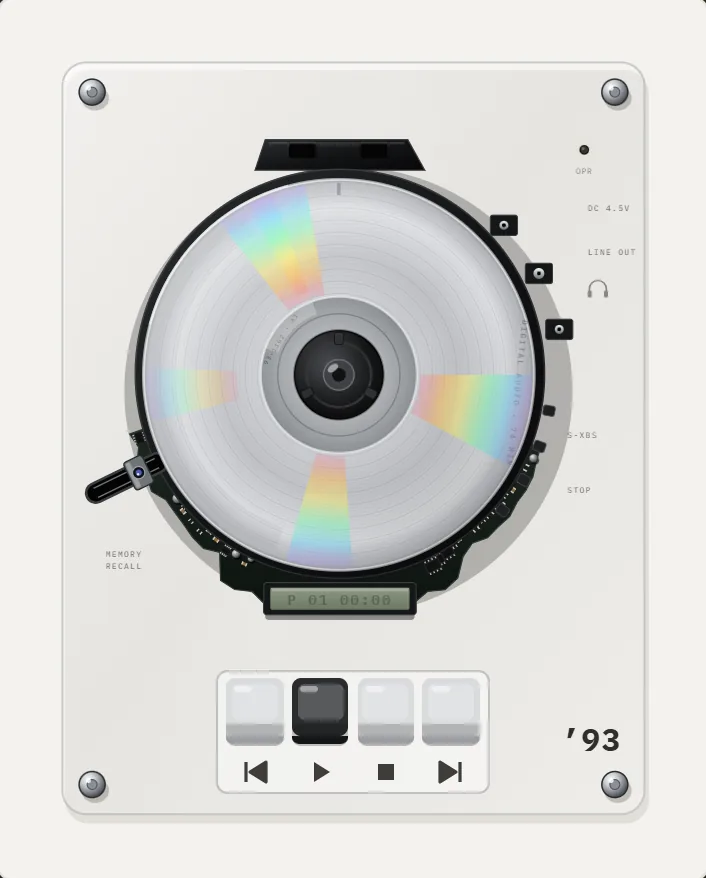 Anti-Skip CD Players ExplainedHow anti-skip buffers worked in portable CD players, with buffer sizes, battery costs and the shock absorbers they replaced.
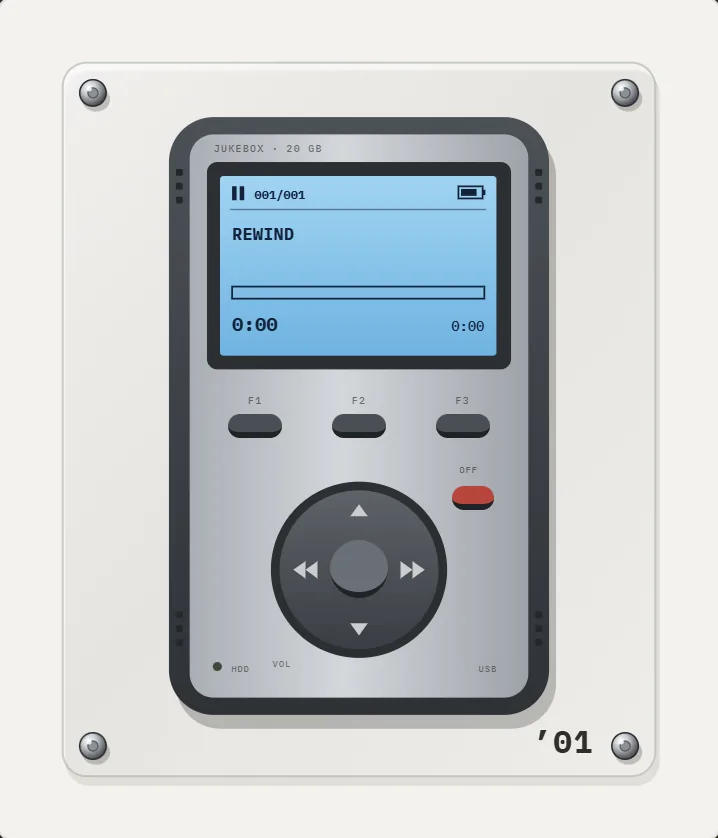 History of the MP3 PlayerFrom the MPMan F10 and Rio PMP300 in 1998 to the 2001 iPod and the smartphone: a dated history of the MP3 player.CD Player App for iPhoneHow portable CD players worked, what a CD player app for iPhone can recreate, and how to use your own rips.1989 Open CD Player App for iPhoneSilver disc over a dense green board, black optical block, white ribbon connector. A PRO ’89 CD machine.2000 Round-Case CD Player App for iPhoneRound black case, small latch, vinyl-style disc with peach-beige label. A PRO millennium-year CD machine.