REWIND
Anti-skip CD players explained: how the memory buffer kept the music going
Anti-skip, also called electronic skip protection or ESP, is a memory buffer inside a portable CD player. The laser reads ahead and stores audio in RAM, so music keeps playing for a few seconds while the laser recovers from a jolt. It appeared around 1995, and early buffers held about 3 seconds.
Download free on iPhoneSee all 30 machines
8 machines free forever · no account · works offline
Why does a portable CD player skip at all?
A CD stores audio as a spiral of tiny pits. A laser reads them through a lens that must stay locked on a spiral track whose windings sit just 1.6 micrometers apart, as the Compact Disc article explains. The disc turns at constant linear velocity, from roughly 500 rpm at the inside to 200 rpm at the outer edge.
Error correction fixes small scratches, but a sharp knock can move the lens off its track for a moment. For that moment the player has no data, and the audio drops out or repeats. Walking, running or riding in a car all create such bumps. A home CD player sits on a shelf, so it rarely faces this.
How does electronic skip protection work?
The player reads the disc faster than it plays it, and stores the extra audio in a RAM chip. The audio output then draws from RAM, not straight from the disc. When a bump interrupts reading, the player keeps playing from memory while the laser finds the passage just before the interruption. As long as the buffer does not run empty, you hear nothing. The skip protection article describes the mechanism.
Two read methods existed. One reads the disc at a fixed speed and buffers the content. The other keeps the usual constant-linear-velocity spin but a bit faster than normal playback. Either way, the buffer refills as soon as the laser is back on track.
Here is the sequence in a typical player:
- A bump knocks the lens off the track and the laser stops reading valid data.
- The player keeps feeding the converter from RAM, so the music continues.
- The tracking circuitry finds the spot on the disc just after the last data in the buffer.
- Reading resumes and the buffer refills, ready for the next bump.
The protection works only while the buffer has audio left. Repeated hard knocks can still cause a skip.
How much music could the buffer hold?
Less than you might think, and the answer depended on RAM cost. The numbers below use the CD data rate of 1,411.2 kbit/s (44,100 samples per second x 16 bits x 2 channels), which is our own arithmetic on top of the sourced figures.
Raw audio fills memory quickly, which is why some makers compressed the stored audio to fit more seconds into cheaper chips. The CD player article says typical players could store about 44 seconds of audio on a 16 Mbit RAM chip.
| Buffer | Seconds of audio | Note |
|---|---|---|
| Around 1995, first generation | About 3 | Maximum when introduced |
| 16 Mbit chip, uncompressed | About 11 | 16 Mbit / 1.4112 Mbit/s |
| 16 Mbit chip, with compression | About 44 | Figure quoted for typical players |
| 2006 players | 10 to skip-free | Larger buffers made skipping rare |
| MiniDisc (from 1992) | At least 10 | The ATRAC format needed it from the start |
What did anti-skip cost?
Two things. First, power. Reading faster and keeping RAM alive uses battery, and older players made between 1992 and 1997 could lose up to half of their battery life with protection switched on. Players from 1997 onward used more efficient circuits. Second, if a maker compressed the stored audio, the sound could degrade a little.
Marketing names included ESP, Anti-Skip, Anti-Shock, Joggable and G-Protection. The pitch was a player you could take on a run.
Protection traded some battery and, with compression, a little fidelity for freedom of movement. A longer buffer made a player more forgiving on a rough road.
What came before the buffer?
Rubber shock absorbers. Makers floated the mechanism on springy mounts that absorbed bumps, but those parts were bulky. The buffer arrived around 1995 as a physically smaller alternative, and it let the players shrink, particularly the ones designed for cars. Small rubber absorbers stayed in use, though they are less effective than the large pre-1995 designs.
The mechanism also mattered: the CD player article notes that a swing-arm laser assembly does not skip when its rail gets dirty, a problem for radial designs. We cover the wider story in the history of the portable CD player.
Why did anti-skip disappear?
Because flash memory made it unnecessary. Players with no moving parts cannot skip, so there is nothing to protect. The Rio PMP300, introduced in September 1998, was an early example, as described in the history of the MP3 player. Smartphones followed.
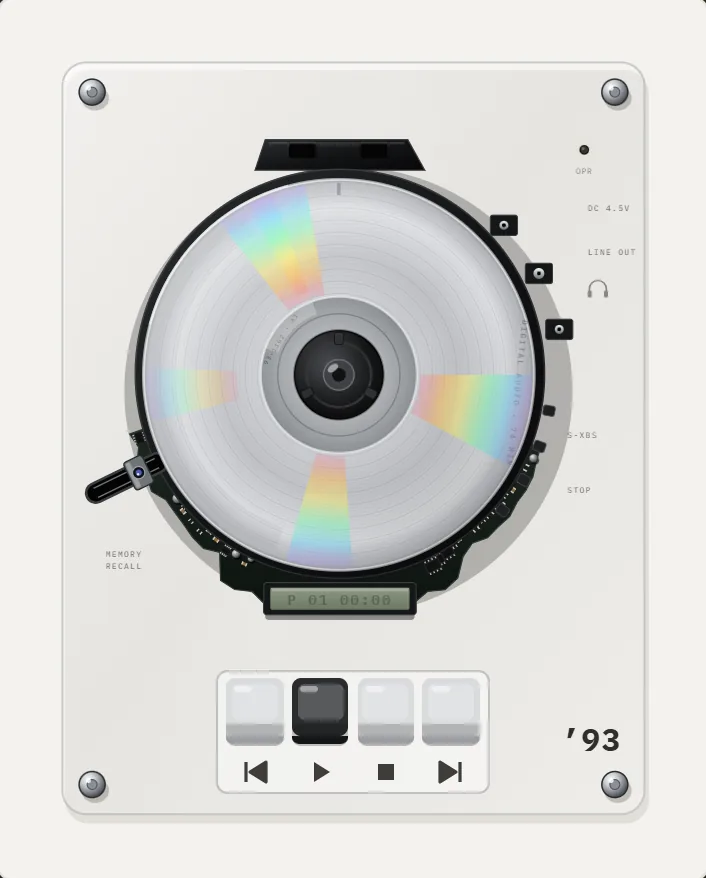
REWIND leans on the same idea. It draws 11 portable CD machines as opened-up players, but it plays your own files from the phone's storage, so there is no disc to bump. Put a finger on the spinning disc to scratch it. Take a look at disc-s570, disc-d777 or the CD player page.
Frequently asked questions
What does ESP mean on a CD player?
ESP stands for Electronic Skip Protection. It is a RAM buffer that keeps music playing for a few seconds while the laser recovers from a shock.
When did anti-skip technology appear in portable CD players?
Electronic skip protection surfaced around 1995. The first buffers held about 3 seconds, and larger ones later pushed the time to 10 seconds or more.
Did anti-skip reduce battery life?
Yes. In players built from 1992 to 1997, battery life could drop by up to fifty percent with protection on. Models from 1997 onward used more efficient circuits.
Why do MP3 players not skip?
They store music in flash memory or on a drive with no laser to knock off a track, so jolts do not interrupt playback in the same way.
Does REWIND have anti-skip?
It does not need it. REWIND draws portable CD players, but it plays audio files stored on your iPhone, so there is no spinning disc to disturb.
Keep exploring
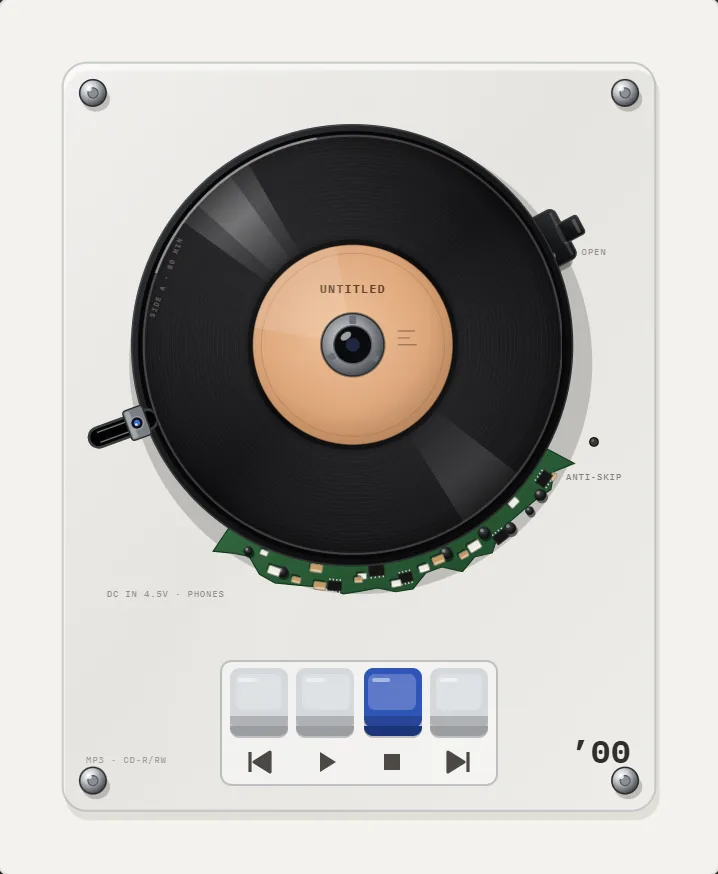 CD players11 opened portable CD players from 1989 to 2005 with scratching.
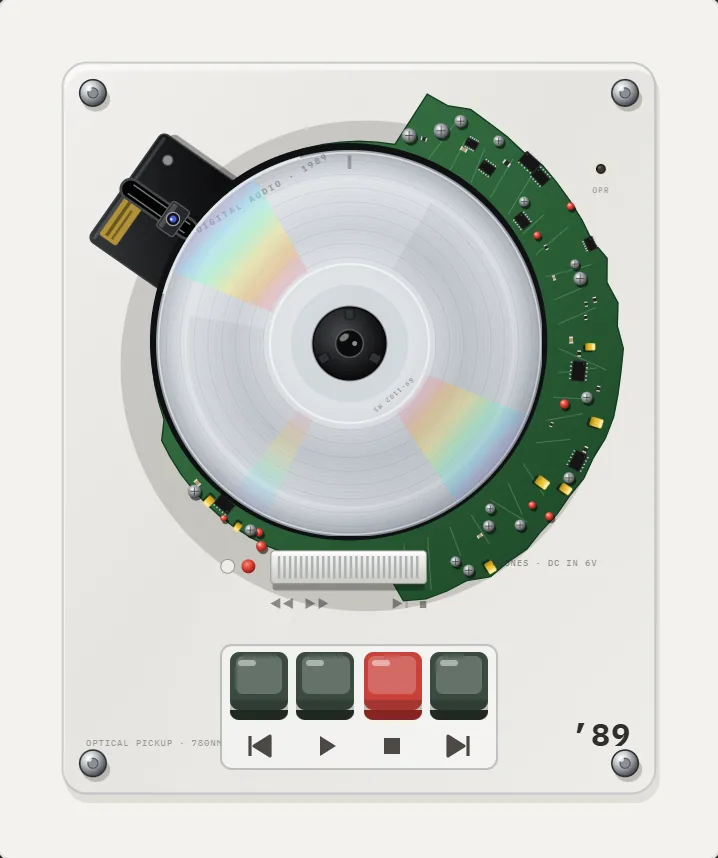 History of the Portable CD PlayerThe Sony D-50 in 1984, rubber shock absorbers, anti-skip memory and the MP3 CD era: a dated history of the pocket CD player.
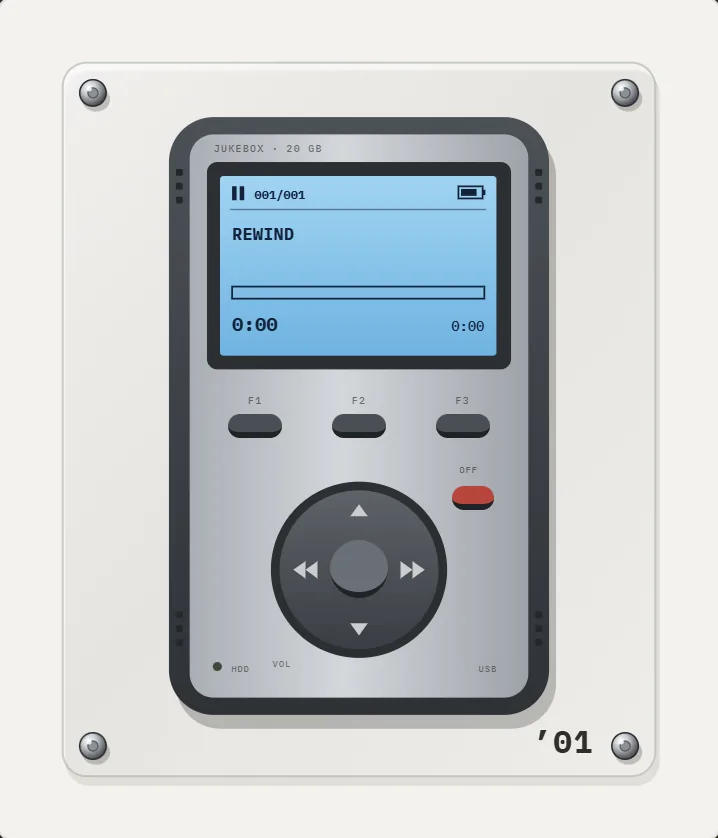 History of the MP3 PlayerFrom the MPMan F10 and Rio PMP300 in 1998 to the 2001 iPod and the smartphone: a dated history of the MP3 player.CD Player App for iPhoneHow portable CD players worked, what a CD player app for iPhone can recreate, and how to use your own rips.1993 Rainbow Disc CD Player for iPhoneBig silver disc with rainbow shimmer, dark board with an LCD strip, small keys on the right. PRO.
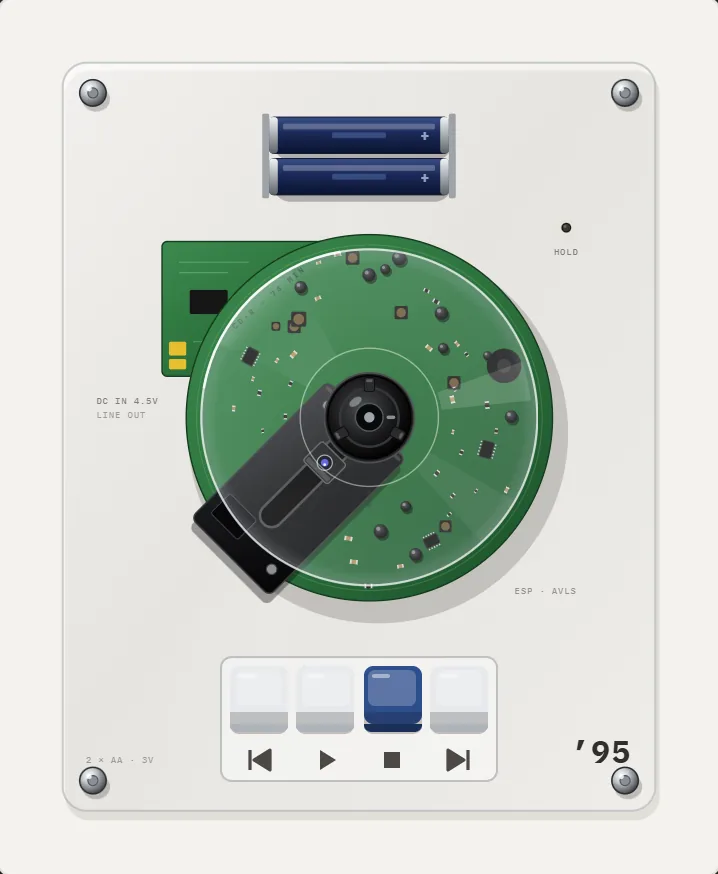 1995 Empty-Disc CD Player MechanismTwo AA batteries, round green board, black spindle and carriage, clear empty disc. A PRO ’95 CD machine.