REWIND
What Is Tape Saturation?
Tape saturation is the gentle rounding of loud peaks that happens when magnetic tape is driven close to its limit. The tape cannot hold unlimited magnetic signal, so peaks bend instead of breaking, adding harmonics and a slight compression. The result sounds warm, dense and slightly softer.
Download free on iPhoneSee all 30 machines
8 machines free forever · no account · works offline
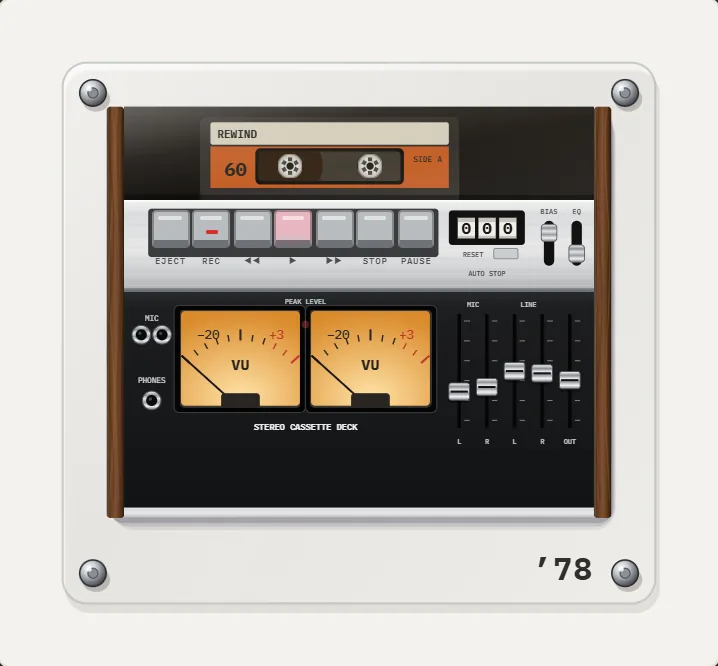
How does a tape record sound?
A recording head turns the audio into a changing magnetic field. The tape passes by, and tiny magnetic particles in its coating line up in patterns that follow the signal. On playback a head reads those patterns back and turns them into voltage (Wikipedia: Magnetic tape sound recording).
This works well until the signal gets large. A particle can only be magnetized so far. Once most are lined up, more current from the head produces less extra magnetism. That limit is saturation.
Why does saturation sound warm, not harsh?
Digital clipping flattens a waveform's peak abruptly. Tape saturation rounds it gradually, which engineers call soft clipping. The shape of the bend determines which harmonics are added, and tape tends to add mostly low-order ones, often the third. Those harmonics sit musically close to the original note, so the ear reads them as richness instead of distortion.
There is also a compression effect. As peaks soften, the loud parts shrink relative to the quiet parts, so drums feel thicker and vocals sit a little more firmly in the mix. Engineers in the era of studio tape pushed levels on purpose to get that.
What is tape bias and why does it matter?
Magnetic tape responds badly to small signals: with no help, quiet sounds come out distorted. The fix is bias, a very high-frequency tone, typically well above the range of hearing, mixed in with the audio during recording. It pushes the signal into the part of the tape's response where it behaves nearly linearly. The benefit of AC bias was rediscovered in 1940 by Walter Weber at German radio, who was working on a Magnetophon (Wikipedia: Tape bias).
Set the bias right and the tape records quiet detail cleanly while saturating gracefully on peaks. Set it wrong and you get dull treble or crunchy distortion. Cassette types differ in the bias and equalization they expect, which is why the normal, chrome and metal tape types exist.
Is saturation the same as hiss?
They are separate effects with different causes. Hiss is steady noise produced by the grain of the magnetic particles and the electronics, and it is audible even in silence. Saturation happens only when the signal is loud. Dolby B, introduced for cassette in 1968, was a noise-reduction system aimed at hiss (Wikipedia: Dolby noise-reduction system).
A third effect, wow and flutter, is a speed error. Together these three, plus a gentle loss at the highest frequencies, describe most of what we call the tape sound.
How can you hear saturation on your phone?
You can add it to ordinary digital files in real time. In REWIND, tape saturation is one of the sliders in analog sound, alongside wobble, hiss and vinyl crackle. The processing runs on the device, and it works offline.
- Pick a dynamic track, such as a drum-driven rock song, and import it from the Files app.
- Start playback on a cassette machine and switch on Analog sound.
- Set hiss and wobble to zero so only saturation changes.
- Raise tape saturation slowly. Listen to the drums and the loudest vocal line, where the rounding is easiest to hear.
- Stop where the sound gets denser but still clear, then add a little hiss if you want.
How much is too much?
Past a point, saturation adds fuzz and dulls detail. Signs of too much: cymbals lose their shimmer, bass starts to blur, and a quiet song sounds congested. Back the slider down when you hear any of that.
Pair it with the equalizer. Its five bands sit at 60 Hz, 250 Hz, 1 kHz, 3.5 kHz and 12 kHz, with Flat, Warm, Bass, Vocal and Air presets. The Warm preset suits saturation, and Air restores some of the top end that heavy settings take away.
One more habit worth building is level matching. Saturation makes a song seem slightly louder and fuller, and louder usually sounds better to the ear whether or not it is. Compare with the effect on and off at the same volume, so you pick it because the sound improved and not because it got louder.
Why did studios chase it?
Tape was the recording medium for decades, and engineers learned to use its limits. Hitting tape hot gave drums more weight and glued mixes together without extra gear. Even after digital recording arrived, many studios kept running parts of a mix through tape machines for the character. Many plug-ins now model tape.
The reason is practical. A mix that sounds fine on a sterile system can feel flat on small speakers, and a gentle saturation adds harmonics that survive tiny speakers better than a pure low note does.
Does cassette saturate differently from reel-to-reel?
Yes. Cassette tape is narrow, 3.81 mm wide, and moves at 1.875 inches per second. A professional reel-to-reel machine runs wider tape at higher speeds, such as 15 inches per second, with much more headroom. Cassette therefore saturates earlier, loses more treble and has more hiss.
That explains the ranking of how machines feel. The 1974 reel-to-reel in REWIND, with its big turning reels and twin VU meters, reads as the high-fidelity ancestor, while pocket cassettes read as the compressed, intimate cousin. Start with saturation low on the reel machine and a bit higher on a pocket cassette.
Frequently asked questions
What is tape saturation in simple terms?
It is the soft rounding of loud peaks that happens when magnetic tape is pushed to its limit. It adds harmonics and mild compression, which sounds warm.
Is tape saturation the same as distortion?
It is a gentle kind of distortion. Tape rounds peaks gradually and adds mostly low-order harmonics, unlike the harsh flat-topping of digital clipping.
What does tape bias do?
Bias is a high-frequency tone mixed in during recording. It makes the tape respond more linearly, so quiet sounds record cleanly.
Can I add tape saturation to MP3s on iPhone?
Yes. REWIND has a tape saturation slider in its analog sound controls and applies it in real time to files you import.
Keep exploring
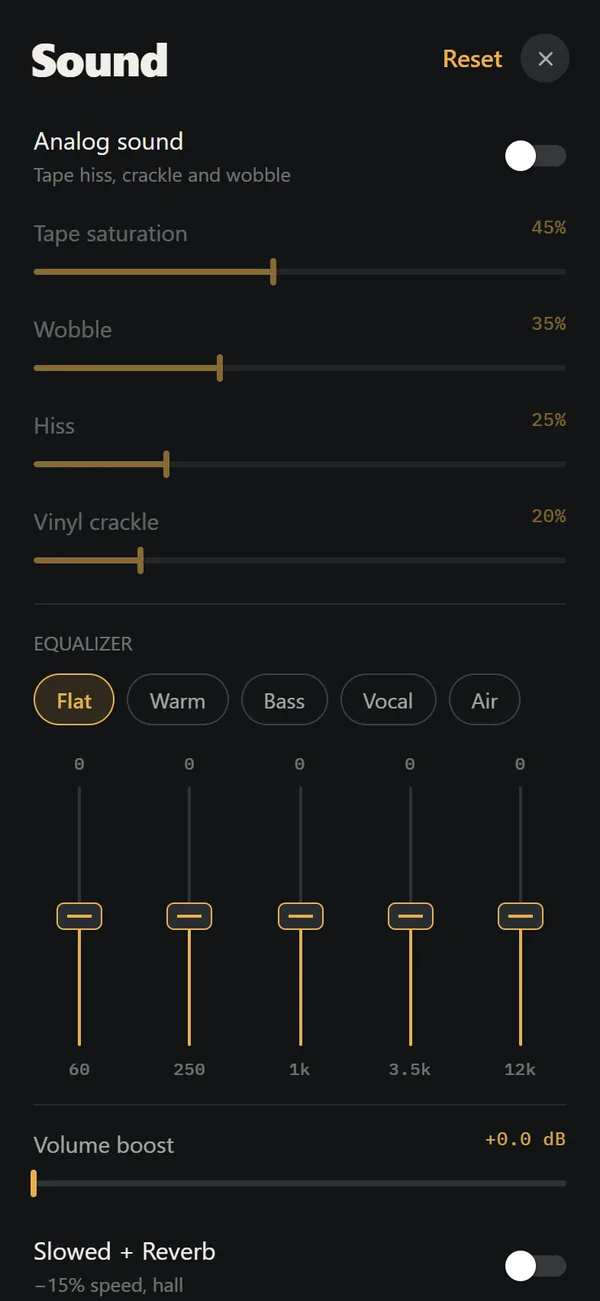 Analog Sound on iPhoneFour sliders (saturation, wobble, hiss, crackle), automatic machine sound and a lo-fi radio filter, live on your own files. Free.
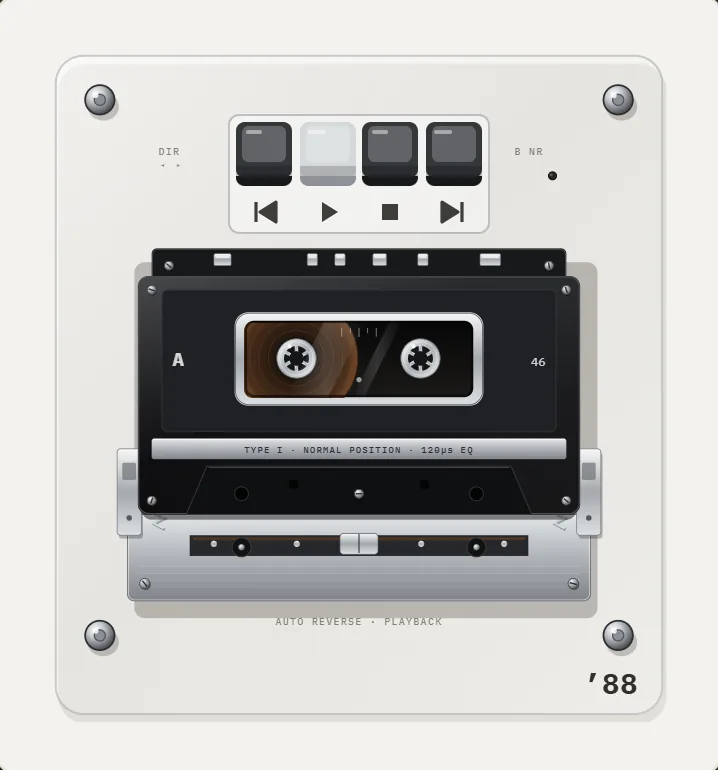 What Is Wow and Flutter? Tape and Vinyl Pitch DriftWhat causes wow and flutter, how it is measured in percent, and how to add a gentle amount back to digital music.
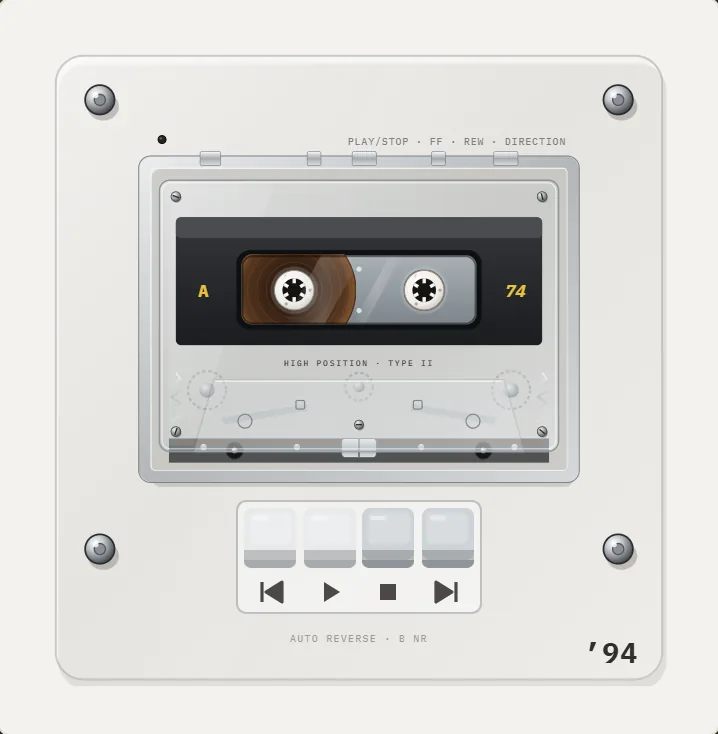 Cassette Tape TypesNormal, chrome and metal cassettes compared: coatings, bias, equalization, notches and what to use today.5-Band Equalizer for iPhone Music Files, FreeFive bands (60 Hz to 12 kHz) and five presets, applied in real time to your own files. Free.Cassette decksA 1978 walnut-sided cassette deck with piano keys, counter and two amber VU meters.1978 Hi-Fi Cassette Deck App for iPhoneWalnut sides, smoked lid with your cassette, gray piano keys, counter and two amber VU meters. PRO.