REWIND
How does a record player work?
A record player spins a vinyl disc on a platter while a diamond-tipped stylus rides in the spiral groove. The groove's wiggles shake the stylus, a cartridge turns that shaking into a tiny electrical signal, a phono preamp boosts and corrects it, and an amplifier sends it to speakers.
Download free on iPhoneSee all 30 machines
8 machines free forever · no account · works offline
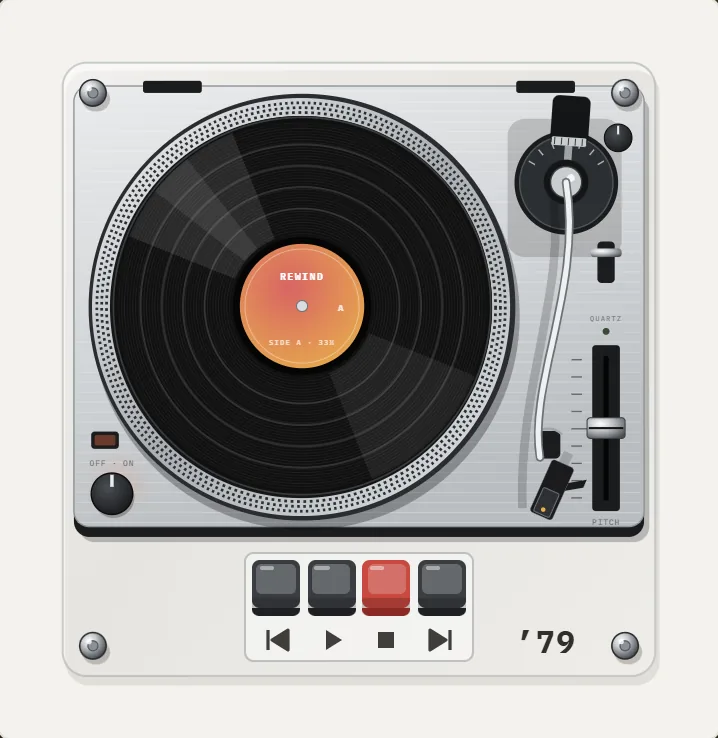
What are the main parts of a record player?
A record, also called a phonograph record or vinyl record, is a disc with a modulated spiral groove that starts near the outer edge and ends near the center (Wikipedia: Phonograph record). Every part of the player exists to read that groove without damaging it.
| Part | Job |
|---|---|
| Platter | Carries the record and turns it at a steady speed |
| Motor and drive | Spins the platter by belt, direct drive or idler wheel |
| Tonearm | Holds the cartridge and lets it follow the groove inward |
| Cartridge and stylus | Stylus rides the groove; cartridge converts motion into electricity |
| Phono preamp | Boosts the weak signal and restores the intended tone |
| Amplifier and speakers | Make the signal loud enough to hear |
How does the stylus turn a groove into sound?
The groove walls are cut with the waveform of the music. For a stereo record, each wall carries one channel, and the two walls sit at right angles, so a single stylus picks up left and right at once. Stereo records became widely available in 1958.
As the record turns, the stylus tip, a tiny diamond, is pushed side to side and up and down. Attached to it is a small magnet or coil inside the cartridge. When the magnet moves near a coil, it induces a voltage that follows the groove shape. Modern cartridges produce only a few millivolts, which is far weaker than the signal from a phone or CD player (Wikipedia: Phono input).
Why is a phono preamp needed?
Two things have to be fixed before the signal can reach a normal amplifier input. First, it is too weak, so the preamp boosts it. Second, records are cut with the bass cut and the treble boosted, to save groove space and reduce surface noise. During playback the preamp does the reverse, which is called RIAA equalization.
Many turntables have a preamp built in, with a switch marked Phono/Line. Others rely on a preamp in the amplifier or a separate box. Plugging a turntable without a preamp into a line or AUX input gives a quiet, thin sound. The tonearm also needs a ground wire to the preamp to stop hum.
How do I play a record, step by step?
- Wipe the record with a carbon-fiber or microfiber brush from the center out, and check the stylus is not dusty.
- Set the speed switch to match the record: 33 for LPs, 45 for most 7-inch singles.
- Place the record on the platter. Put the 45 adapter on the spindle for 7-inch singles with a large hole.
- Release the tonearm clip and lift the arm with the cue lever.
- Move the arm over the first groove and lower the cue lever slowly. On an automatic player, press Start instead.
- When the side ends, the stylus reaches the run-out groove. Lift the arm, return it to its rest, and turn off the platter.
Never drag the stylus across a record or place it down by dropping the arm. That is how grooves wear.
Belt drive, direct drive or linear tracking?
These describe how the platter is turned and how the arm moves, and each has its fans. A belt-drive turntable uses a rubber belt that isolates motor noise. A direct-drive one puts the motor under the platter and starts quickly. A linear-tracking turntable moves the arm along a straight line, like the cutting lathe. The detail is in belt-drive vs direct-drive and in linear tracking turntables explained.
Can I play a record without a record player?
Not with good results. A record needs a stylus and something to amplify the vibrations. Old tricks with a needle and a paper cone show the principle but produce a faint sound and can damage the groove. If you only want to hear the content, look for a digital copy or a DRM-free download, which the guide to where to buy DRM-free music lists. For connecting a real turntable to a phone, see how to connect a record player to an iPhone.
What does the tonearm do?
The tonearm holds the cartridge at the right angle and height and lets it swing across the record as the groove spirals inward. Two settings matter. Tracking force, often between 1 and 3 grams (check your cartridge's spec), presses the stylus into the groove. Anti-skate gently counters the sideways pull that the spinning record puts on the arm, so both channels track evenly.
Too little force makes the stylus bounce out of the groove. Too much wears the record and the stylus. The arm should also be level, with the record lying flat. This is one reason a warped record can skip even on a good player.
Why does vinyl crackle, and how does REWIND mimic it?
Crackle is dust and microscopic damage in the groove being hit by the stylus. The reasons are in why vinyl crackles. REWIND shows a direct-drive turntable and others, with the tonearm travelling across the record as your own song plays, and an optional crackle setting in analog sound. It does not play physical records. It plays audio files stored on your iPhone.
Frequently asked questions
What is the needle on a record player called?
The needle is called a stylus. It has a diamond tip and sits at the end of the cartridge, which is clamped in the tonearm.
Do I need a speaker or amplifier for a record player?
Yes, unless the turntable has them built in. A normal turntable needs a phono preamp, an amplifier and speakers. Powered speakers with a Phono input skip a separate amplifier.
How do you get a record player to play?
Connect it to power and to an amplifier or speakers, set the speed, put the record on, and lower the tonearm onto the first groove. Check the Phono/Line switch if the sound is quiet.
How fast does a record player spin?
Common speeds are 33 and a third rpm for LPs, 45 rpm for singles, and 78 rpm for older shellac records.
Why does my record player sound quiet or hum?
A missing phono preamp makes it quiet, and a missing ground wire from the tonearm to the preamp makes it hum. Check both before blaming the record.
Keep exploring
Turntables3 turntables: suitcase, linear-tracking and direct-drive, with scratching and crackle.Belt-Drive vs Direct-Drive TurntablesBelt or direct drive? How each turntable drive works, where each wins, and why DJs settled on the Technics SL-1200.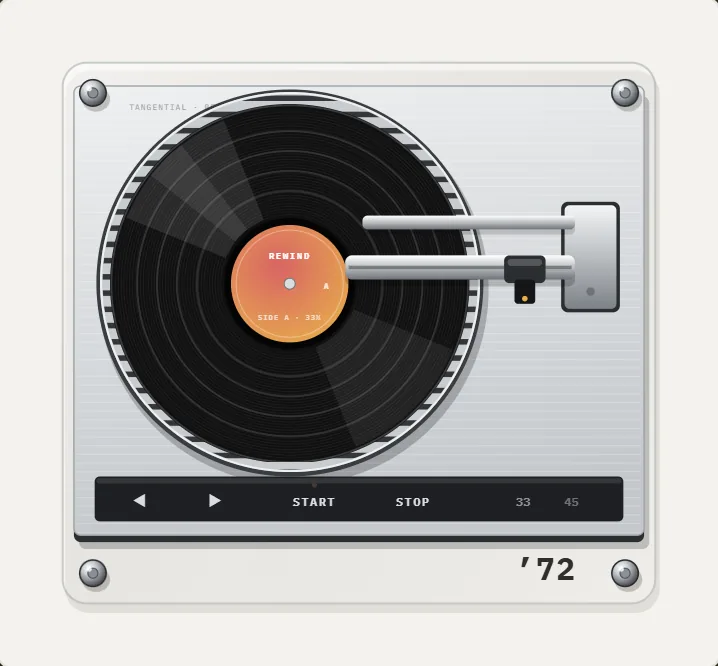 Linear Tracking Turntables ExplainedHow a tangential tonearm avoids tracking error and skating force, with the Technics SL-10 as the landmark and the trade-offs.
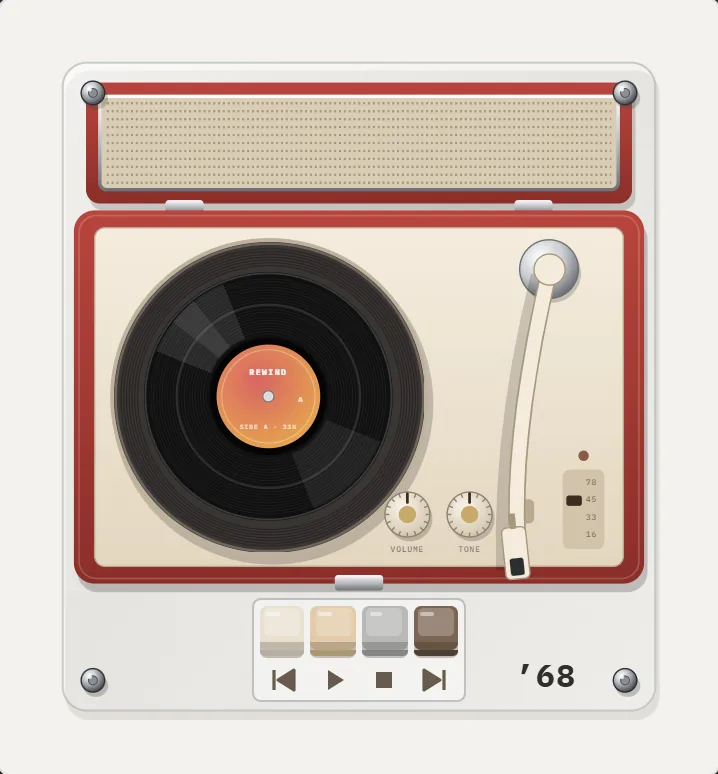 Why Vinyl CracklesThe physical reasons vinyl crackles, how a stylus reads a groove, and how to add or avoid the sound.How to Connect a Record Player to an iPhoneThree ways to join a turntable and an iPhone: phone into player, player to Bluetooth, and vinyl recorded to your phone, with gear lists.1979 Direct-Drive DJ Turntable for iPhoneSilver deck on rubber base, strobe-dot platter, orange lamp, S-shaped tonearm, pitch slider. A PRO ’79 DJ turntable.