REWIND
Belt-drive vs direct-drive turntables: how they differ and who each suits
A belt-drive turntable spins the platter with a rubber belt from an off-center motor, which damps motor vibration and suits quiet home listening. A direct-drive turntable puts the motor right under the platter, which gives high torque, quick start-up and the ability to scratch. Matsushita released the first direct-drive model, the Technics SP-10, in 1969.
Download free on iPhoneSee all 30 machines
8 machines free forever · no account · works offline
Which is better, belt drive or direct drive?
Neither wins everywhere. Belt drive is usually chosen for listening at home, because the belt keeps motor vibration away from the stylus. Direct drive is the standard for DJs, because the platter keeps its speed when a hand pushes on the record. A third design, the idler wheel, uses a rubber wheel between motor and platter and is mostly a vintage type.
The comparison below summarizes the belt-drive and direct-drive descriptions on Wikipedia.
| Belt drive | Direct drive | |
|---|---|---|
| Motor position | Off-center, under or beside the platter | Directly under the platter's center |
| Coupling | Elastic belt | None; the motor turns the platter |
| Motor vibration reaching the stylus | Absorbed by the belt | Higher unless damped |
| Torque and start-up | Lower, slower to reach speed | High, reaches speed quickly |
| Scratching and backspinning | Can stretch or damage the belt | Platter keeps spinning, motor unharmed |
| Typical user | Home listener, audiophile | DJ, turntablist, radio station |
How does a belt-drive turntable work?
The motor sits off to one side or underneath, and a thin loop of elastomer connects its pulley to the platter or to a sub-platter. Two practical benefits follow. The motor can be simpler and cheaper, and the stretchy belt absorbs vibration that would otherwise travel into the plinth and the stylus.
Speed stability is the hard part. Makers use heavy platters for inertia, synchronous AC motors that produce a smooth rotation, optical sensors on the platter, or servo circuits that correct small errors. Many classic hi-fi decks use a suspended sub-chassis, a design Edgar Villchur brought to the Acoustic Research XA turntable in 1961, so the platter and arm float on springs, away from outside vibration.
How does a direct-drive turntable work?
There is no belt. The motor's rotor sits under the platter and turns it directly, and in some designs the platter itself is the rotor. Shuichi Obata, an engineer at Matsushita (now Panasonic) in Osaka, developed the idea. The company released the SP-10 in 1969 as the first direct-drive turntable on the market, and the brand name was Technics.
The torque is the point. Because the platter is hard to slow down, it comes up to speed quickly and holds it, so the pitch is steady at the start of a record and when a hand touches the edge. Quartz-controlled speed, used on the Mark 2 from 1979, regulates speed even more tightly. The cost is motor vibration, which makers reduce with damping material between motor and platter.
Why did DJs choose direct drive?
A DJ pushes the record back and forth with a slipmat under it, which is a felt sheet that lets the record slide while the platter keeps turning. A belt can stretch or break under that treatment. A direct-drive motor keeps spinning at the correct speed even if the record is wiggled, which is how scratching became possible. We explain the technique in how DJ scratching works.
The best-known model is the Technics SL-1200. Developed in 1971, it was introduced in October 1972, and the SL-1200 Mark 2 followed in 1979 with quartz-controlled speed. Panasonic announced on 1 November 2010 that it would discontinue Technics turntables, then revived the SL-1200 line at CES in January 2016. The Technics SL-1200 article has the full model history.
DJ decks add a pitch control for fine-tuning speed, used with a strobe light, and that lets a DJ match the tempo of two records (beatmatching). From the late 1990s, makers such as Vestax added reverse and nudge buttons. None of that works well unless the platter responds to a hand and recovers its speed at once, which is what high torque delivers.
Which should you buy for home listening?
For records you just want to enjoy, a belt-drive deck is the safe default, since the design lets makers use a simpler, cheaper motor and the belt filters out vibration. Direct drive is also fine for listening, but check how the motor is damped.
Use this short rule. If you will touch the record to cue, scratch or beatmatch, buy direct drive. If the record only ever spins by itself, either design works, and belt drive is the common choice. Speed accuracy matters in both cases, and it is measured as wow and flutter, which we cover in what wow and flutter mean.
Where can you try a direct-drive deck without owning one?
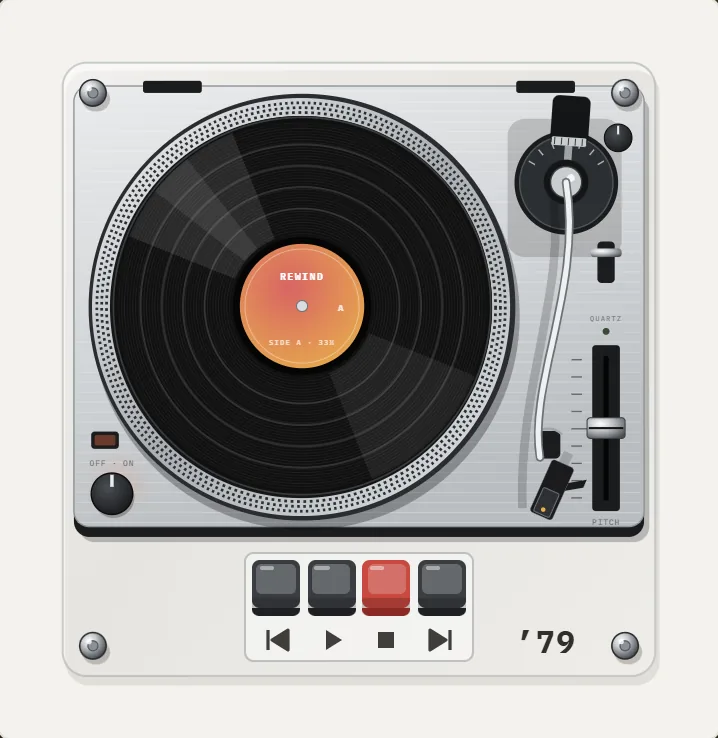
REWIND includes a classic 1979 direct-drive DJ turntable among its 3 vinyl machines. You put a finger on the record to scratch, the tonearm moves across the groove as your own song plays, and a hint of crackle is available in the Analog Sound settings. The other vinyl machines are a 1968 suitcase record player and a 1972 turntable with a linear-tracking arm, covered in linear tracking turntables explained. Start with vinyl-dd79 or the vinyl record player guide.
Frequently asked questions
Is direct drive better than belt drive?
It depends on use. Direct drive is better for DJing because of high torque and fast start-up. Belt drive is often preferred for listening because the belt absorbs motor vibration.
Who invented the direct-drive turntable?
Shuichi Obata of Matsushita (Panasonic) developed it. The SP-10, released in 1969, was the first direct-drive turntable on the market.
Can you scratch on a belt-drive turntable?
You can try, but the belt can stretch or break from backspinning and repeated stopping. Direct-drive motors are designed to keep running while the record is moved by hand.
What is an idler-wheel turntable?
It is the third main drive type. A rubber wheel sits between the motor and the platter edge. It was common on older record players and is less usual today.
Does REWIND have a direct-drive turntable?
Yes. REWIND draws a classic 1979 direct-drive DJ turntable that you can scratch with a finger, playing your own music files on your iPhone offline.
Keep exploring
Turntables3 turntables: suitcase, linear-tracking and direct-drive, with scratching and crackle.1979 Direct-Drive DJ Turntable for iPhoneSilver deck on rubber base, strobe-dot platter, orange lamp, S-shaped tonearm, pitch slider. A PRO ’79 DJ turntable.How DJ Scratching WorksThe mechanics of scratching: how a hand, a slipmat, a direct-drive motor and a crossfader make the sound, with the main scratch types.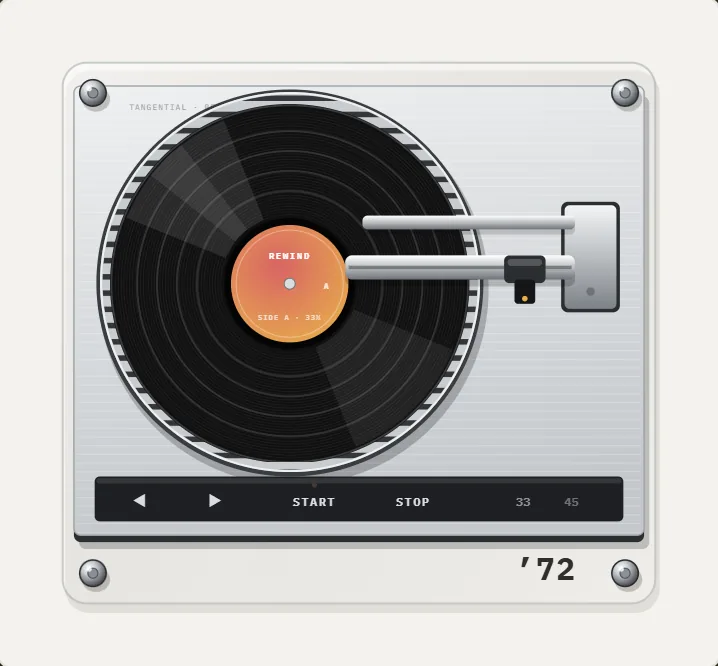 Linear Tracking Turntables ExplainedHow a tangential tonearm avoids tracking error and skating force, with the Technics SL-10 as the landmark and the trade-offs.
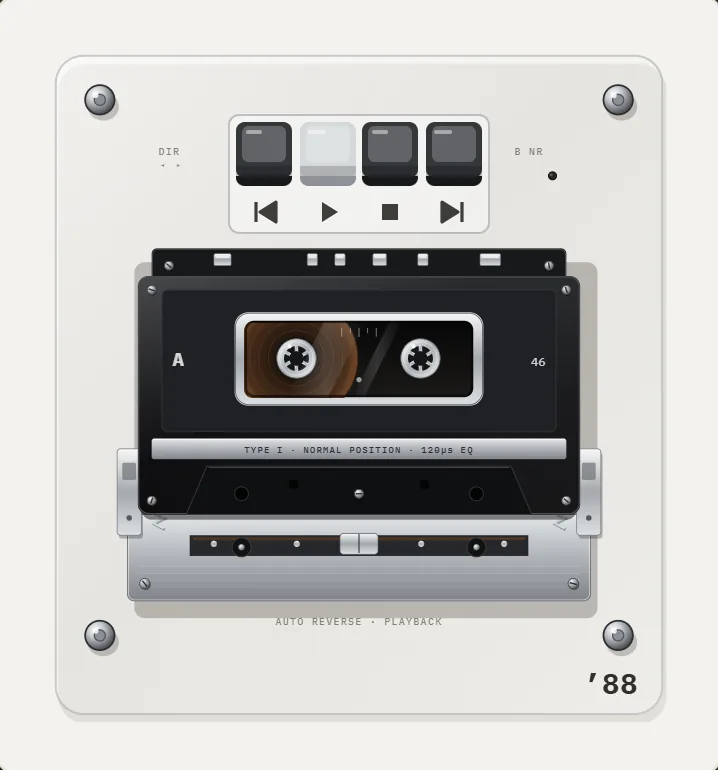 What Is Wow and Flutter? Tape and Vinyl Pitch DriftWhat causes wow and flutter, how it is measured in percent, and how to add a gentle amount back to digital music.Vinyl Record Player App for iPhone, ExplainedWhat a vinyl turntable app actually does on iPhone, which turntable designs exist, and how to get the crackle right.