REWIND
How DJ scratching works: the record, the motor and the fader
DJ scratching is the sound made by pushing a vinyl record back and forth by hand under the stylus while a mixer's crossfader cuts the signal in and out. Grand Wizzard Theodore is credited with discovering it in 1975. It depends on a direct-drive turntable, whose motor keeps spinning while the record is held.
Download free on iPhoneSee all 30 machines
8 machines free forever · no account · works offline
What is scratching, in plain terms?
A turntable reads a record by dragging a stylus through a groove. If the record turns at a steady 33 and a third rpm, you hear the music as recorded. If your hand pushes the record forward faster, the pitch rises. Pull it backward, and the sound plays in reverse. Hold it still, and the sound stops. Scratching is the art of doing those things on purpose and in rhythm.
The practice belongs to turntablism, the use of turntables and a mixer as a musical instrument. The turntablism article says DJ Babu and DJ Disk are both credited with the word turntablist in the 1990s. The sound comes from the record moving in the groove.
Who invented scratching?
Credit goes to Theodore Livingston, known as Grand Wizzard Theodore, a New York DJ. In 1975, the story goes, he was playing records loudly in his bedroom when his mother came to the door and told him to turn it down. He put his hand on the record to silence it, moved it back and forth under the stylus, and noticed the sound. The Grand Wizzard Theodore article retells it.
The groundwork came earlier. DJ Kool Herc, who emigrated from Jamaica to New York, played two copies of the same record on two turntables and switched between them to extend the instrumental break, which dancers loved. Theodore appeared in the 1983 film Wild Style, and the group Run-D.M.C. counted DJ Jam Master Jay as one of its three members.
What equipment makes scratching possible?
Three things: a direct-drive turntable, a slipmat and a mixer with a crossfader. The motor under the platter keeps turning at the correct speed even when a hand holds or wiggles the record. A felt slipmat lets the record slide on the platter without stopping the platter. The crossfader is a slider that moves between the sound of two channels, and a quick tap of it chops the sound into short bursts.
Early belt-drive decks were a poor match: they were slow to start and prone to wear and breakage. We explain why in belt-drive vs direct-drive turntables. The Technics SL-1200 series, introduced in October 1972, has sold more than 3 million units, and since the SL-1200MK2 arrived in 1979 it has been the most common turntable for DJing and scratching.
What are the main types of scratch?
Dozens exist, and turntablists name and combine them. The ones below are described in the turntablism article, with their credited inventors where the sources name them.
| Scratch | What you do | Credited to |
|---|---|---|
| Baby scratch | Push the record forward and back under the stylus, no fader | Not credited |
| Tear | Pull the record back with a brief pause mid-stroke: one forward sound, two distinct backward sounds | Not credited |
| Transform | Click the fader on and off while moving the record | Associated with DJ Cash Money and DJ Jazzy Jeff, Philadelphia |
| Chirp | Move the record while closing the fader at the same time | DJ Jazzy Jeff |
| Flare | Start with the sound on, then cut it with quick fader clicks | DJ Flare, 1987 |
| Crab | Push the record and flick the fader with several fingers in quick succession | DJ Qbert |
| Orbit | A forward and backward record movement combined, often with flares | DJ Disk |
Why does the sound change when the record moves?
The stylus converts groove wiggles into an electrical signal. The speed at which the groove passes decides the frequency of what you hear. Halve the speed and the pitch drops by an octave. Reverse the direction and the groove is read backward. A flat piece of vocal or a drum hit becomes a squelch or a chirp because both pitch and volume change as the hand moves.
The crossfader adds a second control. By opening and closing it, the DJ can pick out only the best slice of the movement, hiding the part where the record returns. That is what turns a simple back-and-forth into a rhythmic pattern, and it is the idea behind the transform and the flare.
Do you still need vinyl to scratch?
No. Many turntablists now use vinyl emulation software that reads a timecode record and drives digital audio, and people also scratch on CD players and controllers. The physical turntable is still the reference instrument, since the motor, platter and tonearm give you resistance and feel.
For the sound of the needle in the groove itself, see why vinyl crackles.
Can you scratch on an iPhone?
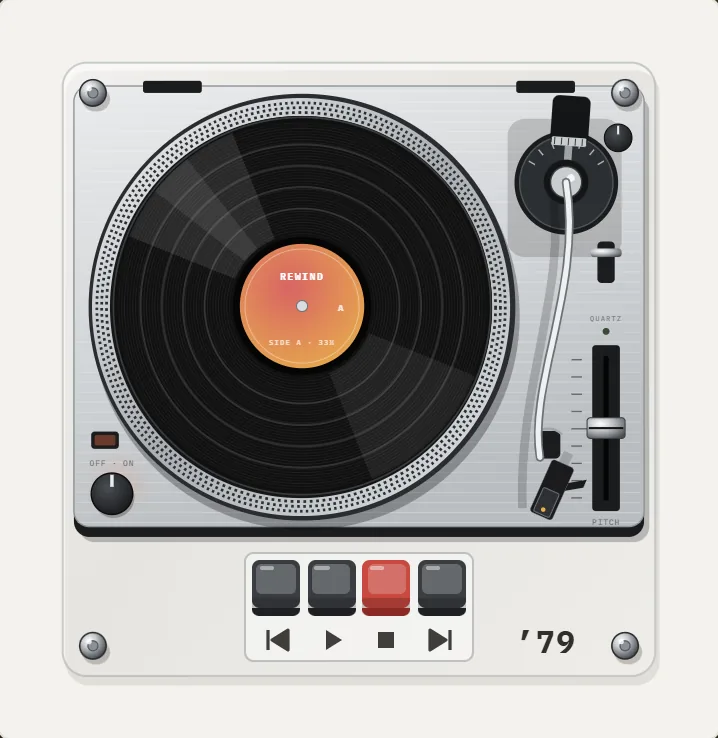
A little. In REWIND you put a finger on a record or a CD to scratch it, and the buttons click as you press them. The 1979 vinyl-dd79 is a classic direct-drive DJ turntable among the 3 vinyl machines, and the tonearm moves across the record as your own song plays. REWIND is a music player, not DJ software, so there is no crossfader or second deck. Try the vinyl record player page or the CD player page for the disc version.
Frequently asked questions
Who invented scratching?
Grand Wizzard Theodore (Theodore Livingston) is widely credited with discovering scratching in 1975, when he moved a record back and forth under the stylus.
Why do DJs use direct-drive turntables?
The motor under the platter keeps the correct speed even while a hand moves the record. Early belt-drive decks were slow to start and prone to wear and breakage.
What is a slipmat?
A slipmat is a felt mat between the record and the platter. It lets the record slide while the platter keeps turning, which makes scratching and cueing possible.
What is the difference between a baby scratch and a transform?
A baby scratch moves the record forward and back without the crossfader. A transform adds rapid fader clicks to chop the sound while the record moves.
Can I scratch in REWIND?
You can put a finger on a record or CD in REWIND and scratch it. It is a player, not a DJ mixer, so it has no crossfader or second turntable.
Keep exploring
Turntables3 turntables: suitcase, linear-tracking and direct-drive, with scratching and crackle.1979 Direct-Drive DJ Turntable for iPhoneSilver deck on rubber base, strobe-dot platter, orange lamp, S-shaped tonearm, pitch slider. A PRO ’79 DJ turntable.Belt-Drive vs Direct-Drive TurntablesBelt or direct drive? How each turntable drive works, where each wins, and why DJs settled on the Technics SL-1200.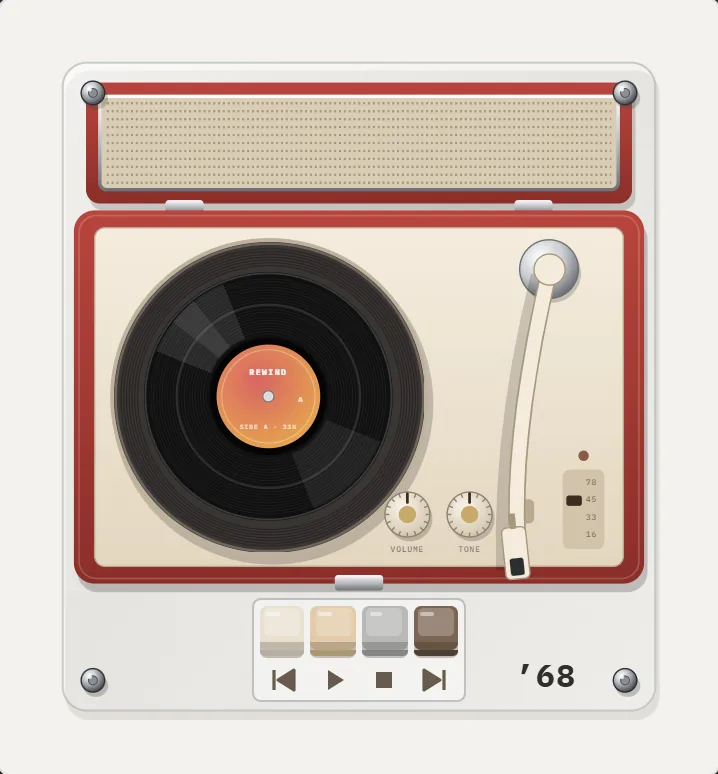 Why Vinyl CracklesThe physical reasons vinyl crackles, how a stylus reads a groove, and how to add or avoid the sound.
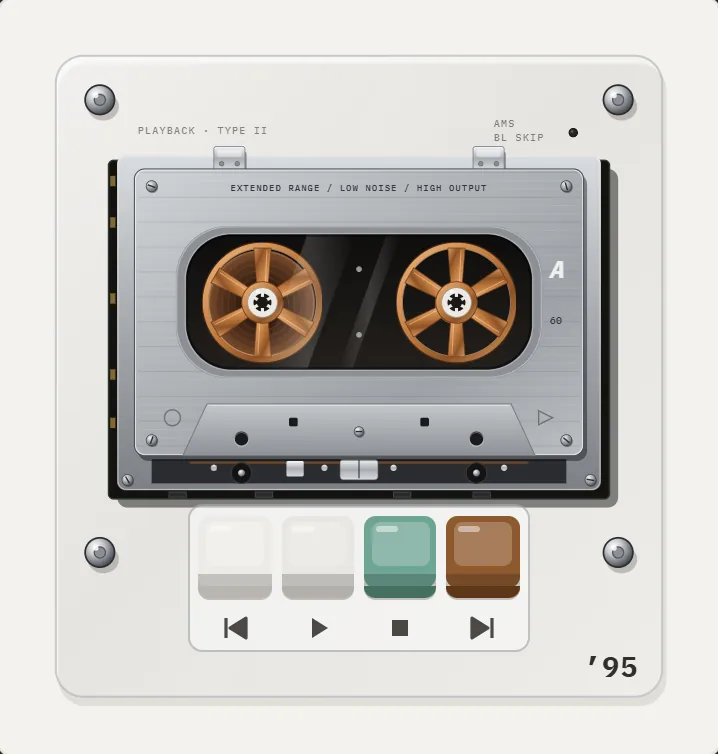 Tactile Retro ControlsSwipe to wind, finger to scratch, buttons that click, a real tape stop. Sounds are synthesized on device.Vinyl Record Player App for iPhone, ExplainedWhat a vinyl turntable app actually does on iPhone, which turntable designs exist, and how to get the crackle right.