REWIND
Linear tracking turntables explained: the arm that goes straight
A linear tracking turntable moves its tonearm in a straight line across the record, so the stylus stays tangent to the groove from the first track to the last. That removes the tracking-angle error of a pivoted arm. The Technics SL-10, built from 1979 to 1985, brought the design to ordinary living rooms.
Download free on iPhoneSee all 30 machines
8 machines free forever · no account · works offline
What is a linear tracking turntable?
It is a record player whose tonearm is not pivoted at one end. Instead the arm, or a small carriage holding the cartridge, moves along a straight path that follows the radius of the disc. People also call it a tangential or parallel tracking turntable. Such an arm has no tracking error and no skating force (Wikipedia: Phonograph).
To do that, the arm must creep toward the label at exactly the speed the groove spirals inward. A typical 12-inch LP side at 33⅓ rpm runs 20 to 25 minutes while the groove travels roughly 8 to 9 centimeters toward the center. That works out to about 4 millimeters of arm travel per minute, by our rough arithmetic. It is slow and steady, and technically complicated to get right.
What problem does a pivoted tonearm have?
A pivoted arm swings in an arc. As it sweeps across the record, the angle between the cartridge and the groove changes slightly, and even a small change affects the sound. The second error is skating force: the groove drags the stylus with a force that does not pass through the pivot, which pushes the stylus toward the center. Modern pivoted arms add an anti-skate mechanism, using springs, weights or magnets, to cancel it.
Disc-cutting lathes also move the cutter along a straight radius, which is the argument for copying that path on playback. A pivoted arm can match it only at certain points on the record, and good arm geometry spreads the remaining error out so it stays small. A linear arm has no such compromise.
How does the arm know where to go?
There are two broad answers. High-end designs let the arm ride on a cushion of air, nearly without friction. More affordable designs use a servo: a small motor drives the carriage along a rail, and a sensor watches for sideways deflection of the arm. When the groove nudges the stylus, the sensor tells the motor to catch up (Wikipedia: Phonograph).
Either way, the arm has to move gently so it adds no noise of its own, which is why these decks demand good engineering.
Why was the Technics SL-10 a landmark?
Linear arms existed before it, but they were specialist and costly. The Technics SL-10 changed the picture. It was built from 1979 to 1985 and was the first linear tracking turntable with direct drive, a Technics idea that dated to the 1969 SP-10. The SL-10 article describes a cast aluminum chassis weighing 6.5 kg, the same size as an LP jacket, with no visible arm or big plinth.
It shipped with a low-output moving-coil cartridge, so it included a built-in, bypassable step-up preamp. The cartridge was meant to be replaced as a unit, and the deck accepts any P-mount (T4P) cartridge. The SL-10 and its programmable sibling, the SL-15, spawned a wave of imitators through the 1980s. For the drive side of this story, see belt-drive vs direct-drive turntables.
Pivoted arm or linear arm: how do they compare?
On paper the linear arm wins, but in practice the pivot won. A pivoted arm is a lever on a bearing. A linear one is a machine with a motor, a sensor and a rail, and anything that wears or drifts out of adjustment can cause trouble. That is why the design stayed a specialist corner of the market without ever disappearing.
| Pivoted arm | Linear (tangential) arm | |
|---|---|---|
| Path across the record | An arc | A straight radius |
| Tracking-angle error | Small but always present | None in principle |
| Skating force | Needs anti-skate | None in principle |
| Mechanical complexity | Low | High: rail, servo or air supply |
| Repair and parts | Easy, many standards | Often model-specific |
| Size | Visible arm and plinth | Can fit inside an LP-sized case |
Should you buy one today?
Only with your eyes open. A used deck can sound excellent, but carriage motors, rails and sensors are model-specific, so check that the arm glides smoothly across the whole record and that the controls and speed switch work. Ask for photos or video of a record playing from start to end. The SL-10 left production in 1985, so parts come from used units.
Four checks before you pay:
- Does the carriage travel smoothly across the whole record, with no stutter or hunting near the label?
- Do the speed switch (33 and 45 rpm), start and stop, and arm lift all work?
- Is a replacement cartridge or stylus available? The SL-10, for one, accepts any P-mount (T4P) cartridge.
- Does it track a record you know well without audible distortion near the label?
Can you try a linear tracking deck on your iPhone?
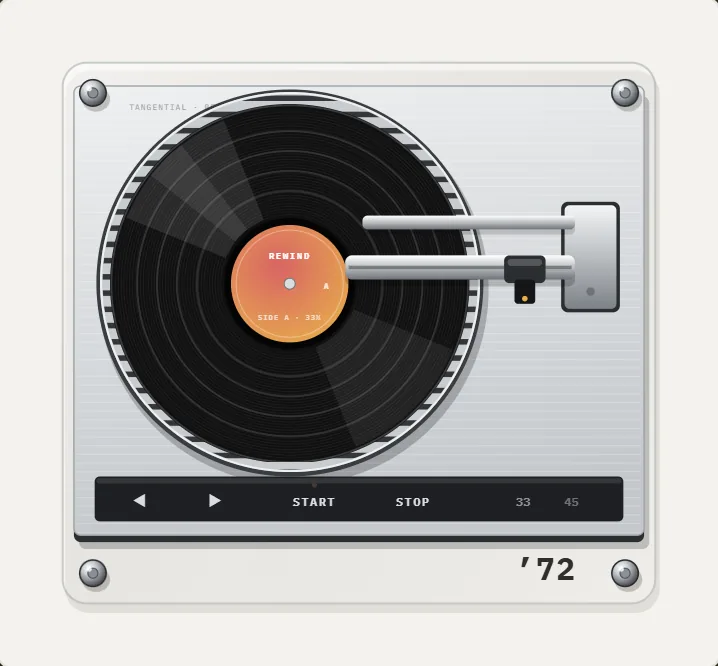
If you like the look and the idea, there is a simpler route. REWIND draws a 1972 turntable with a linear-tracking arm among its 3 vinyl machines, and the arm moves across the record as your own song plays. See vinyl-belt72 and the vinyl record player page. The machine is part of REWIND PRO.
Frequently asked questions
What is a tangential tonearm?
It is a tonearm that moves in a straight line along the record's radius instead of swinging on a pivot. It is another name for a linear tracking arm.
Do linear tracking turntables sound better?
In theory they avoid tracking-angle error and skating force. In practice sound depends on the arm, cartridge and build quality, so a linear deck is not automatically better.
What was the first linear tracking turntable with direct drive?
The Technics SL-10, produced from 1979 to 1985, was the first linear tracking turntable to use direct drive.
Why are linear tracking turntables rare?
They need a rail, a motor and a sensor or air supply to move the arm at the right speed. That complexity made them costlier and harder to repair than a pivoted arm.
Does REWIND have a linear tracking turntable?
Yes. One of REWIND's vinyl machines is a 1972 turntable with a linear-tracking tonearm. The arm moves across the record as your song plays.
Keep exploring
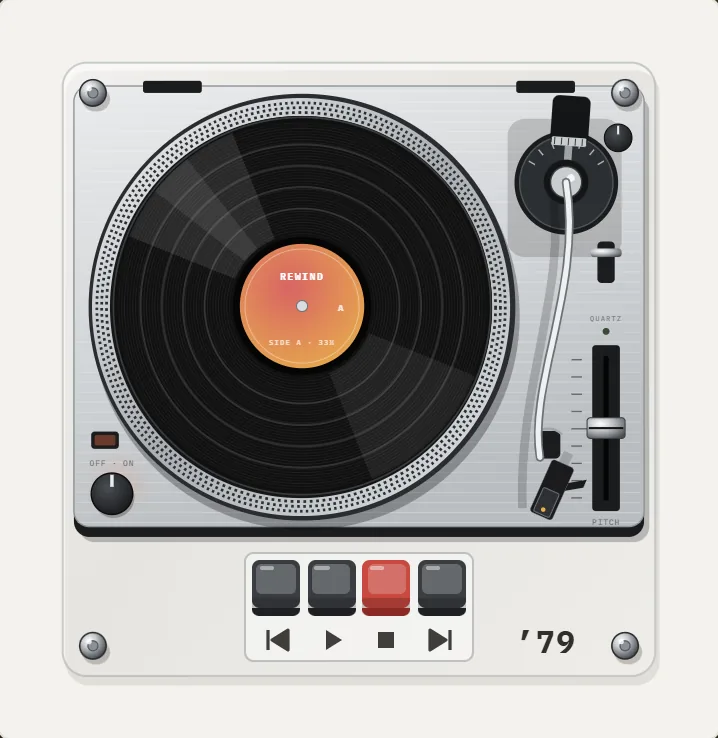 Turntables3 turntables: suitcase, linear-tracking and direct-drive, with scratching and crackle.1972 Linear-Tracking Turntable App for iPhoneLow aluminum deck, ribbed platter, a tonearm carriage on two rods that glides straight. A PRO ’72 turntable.Belt-Drive vs Direct-Drive TurntablesBelt or direct drive? How each turntable drive works, where each wins, and why DJs settled on the Technics SL-1200.
 Why Vinyl CracklesThe physical reasons vinyl crackles, how a stylus reads a groove, and how to add or avoid the sound.Vinyl Record Player App for iPhone, ExplainedWhat a vinyl turntable app actually does on iPhone, which turntable designs exist, and how to get the crackle right.Best Vinyl Record Player Apps for iPhoneSix vinyl record player apps for iPhone compared on price, music sources, features and App Store ratings, October 2026.