REWIND
Can you play any record on any record player?
Mostly, but not any record on any player. Size is rarely the issue, since 7, 10 and 12 inch discs all play. Speed is: a player must offer the record's rpm, usually 33⅓, 45 or 78. Old 78 rpm records also want a different, wider stylus than modern LPs do.
Download free on iPhoneSee all 30 machines
8 machines free forever · no account · works offline
Does record size matter?
Records are described by diameter in inches: 12 in (300 mm), 10 in (250 mm) and 7 in (180 mm). They also use a speed in revolutions per minute, listed as 33⅓, 45 and 78 for the common ones (Wikipedia: Phonograph record). A normal turntable platter is 12 inches wide and holds all three sizes. The tonearm swings in to the right start groove if the player is set up for that size.
Some automatic players only detect 12-inch and 7-inch start positions. If the arm lands in the wrong place on a 10-inch, lower it by hand.
Which speed does each record need?
Speed is the strict rule. If the speed is wrong, the pitch and tempo are wrong, and the music sounds like a different song.
| Record | Usual size | Speed | Notes |
|---|---|---|---|
| LP (long play) | 12 in | 33⅓ rpm | Introduced by Columbia in 1948 |
| Single or EP | 7 in | 45 rpm | 45 rpm single introduced by RCA Victor in 1949; some EPs run at 33 |
| Maxi single, club 12 in | 12 in | 33⅓ or 45 rpm | Check the label |
| Shellac 78 | 10 or 12 in | about 78 rpm | The standard until the late 1940s |
| Special-format discs | varies | 16⅔ rpm and others | Rare; need machines built for them |
Can I play a 45 at 33 or the other way round?
You can, and nothing breaks, but it sounds wrong. A 45 rpm record played at 33⅓ runs at 74 percent speed and drops about five semitones in pitch. A 33⅓ record played at 45 runs at 135 percent and sounds higher by about the same amount. That is why DJs use speed changes on purpose, and why a record slowed down sounds heavy, an effect also used in slowed and reverb edits.
If the player has no 45 setting, there is no way around it. Do not try to push the platter by hand.
What about 78 rpm records?
Shellac 78s are the real compatibility trap. The groove is wider than a modern microgroove, so a stylus made for LPs is too narrow and can ride in the groove bottom, which gives noisy playback. A 78 stylus has a larger tip and is often a separate cartridge, so check your cartridge maker's advice. The record is also more brittle, and a heavy arm can crack it. To play them you need a turntable that offers 78 rpm and a 78 stylus.
The speed was never exact. It differed between places with 50 Hz and 60 Hz mains power, with 78.26 rpm common on 60 Hz systems, and early discs varied more, so a 78 may sound slightly off pitch at a fixed setting. A turntable with variable speed helps.
Will a vintage record hurt a modern turntable, or the opposite?
- A new LP on an old suitcase player is a risk. Those arms are often heavy, and cheap ceramic cartridges can wear the groove.
- A 78 shellac on a modern player without a 78 stylus is a risk to the record.
- A warped record can jump or hit the arm. Use a record flattener or skip it.
- A dirty record puts dust on the stylus. Brush every time.
- Picture discs and colored vinyl play on any turntable, but surface noise is often higher.
What should I check before playing an unknown record?
- Read the label for the speed (33, 45, 78) and the size.
- Look at the grooves in raking light. Wide, deep grooves suggest a 78.
- Set the speed and make sure the stylus suits the groove type.
- Clean the disc and the stylus.
- Set the tracking force to your cartridge maker's recommended value if the arm is adjustable.
- Listen to the first track. If it sounds low, thin or fast, stop and recheck the speed.
What about records with a large center hole or unusual sizes?
A 7-inch single from the US often has a large 1½-inch hole, designed for jukebox spindles. A small plastic adapter, called a 45 adapter, fills the hole so the record sits on a normal turntable spindle. Keep one on the player. Without it, the record will drift off-center and the pitch will wobble.
Odd records exist too. Flexi discs are thin plastic sheets that play on any turntable but wear fast. Picture discs have images under a clear layer. Both are fine to play with a light arm. For very small or large transcription discs, you need a platter that fits them.
Can I hear old 78s and singles without owning the gear?
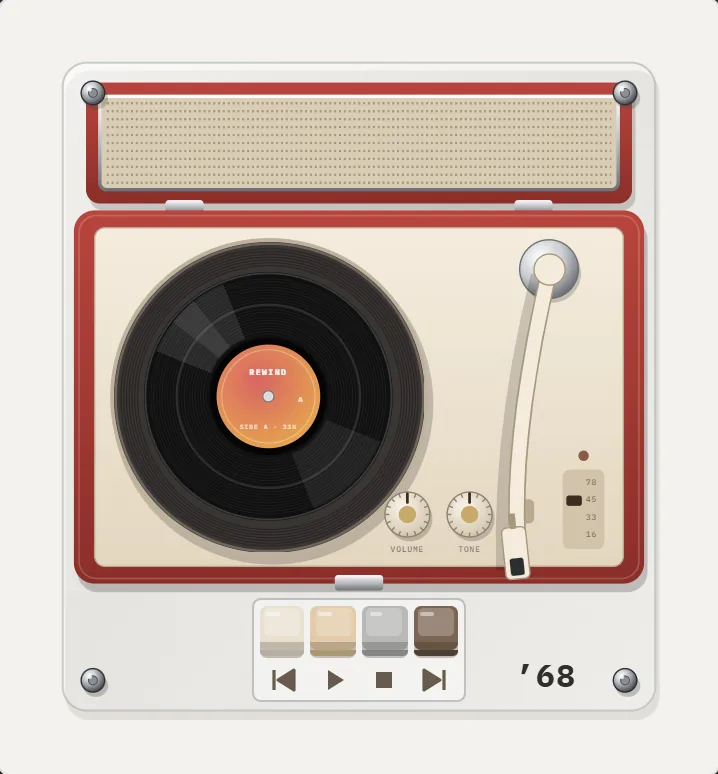
If you have digitized copies or a lawful download of old music, you can play them on your iPhone. REWIND's vinyl machines, such as the 1968 suitcase record player, show the tonearm travelling across the disc as your own song plays. There is no wrong speed to set and no stylus to wear out. For the mechanics of the real thing, read how a record player works, and for speed problems read turntable speed and pitch drift.
Frequently asked questions
Can I play a 78 on a regular turntable?
Only if the turntable has a 78 rpm setting, and ideally with a 78 stylus. A normal LP stylus works poorly on shellac records and the heavy groove can damage it.
Can any record player play 7-inch singles?
Most can. Use the 45 rpm setting and a 45 adapter if the record has a large center hole.
Can a record player play CDs?
No. CDs are read by a laser and have a digital code, while vinyl is read by a stylus in a groove. The two are not interchangeable.
What happens if I play a record at the wrong speed?
The pitch and tempo shift together. A 33⅓ record at 45 rpm runs 35 percent fast, and a 45 at 33⅓ runs 26 percent slow, but the record is not harmed.
Can I play records on a USB turntable?
Yes, the same rules apply. A USB turntable plays vinyl normally and also lets you record to a computer.
Keep exploring
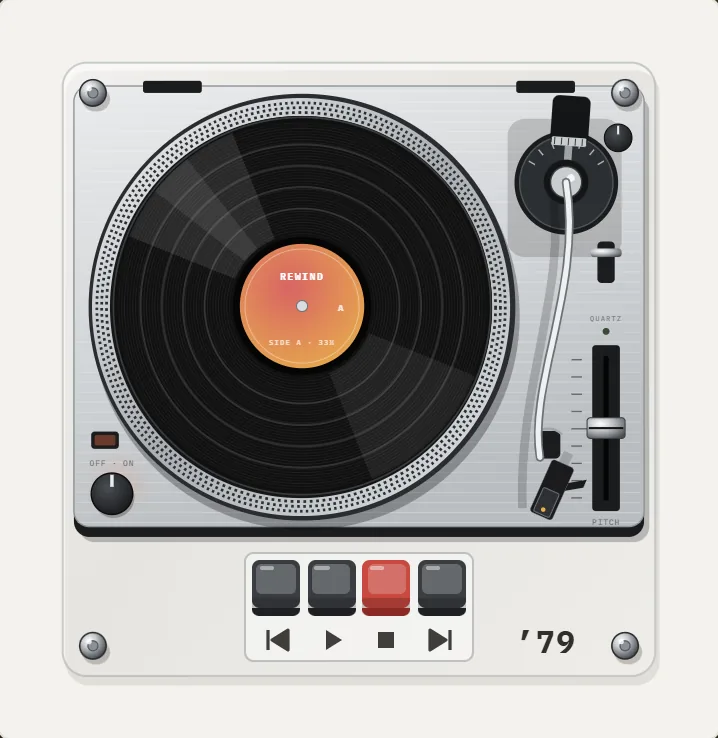 Turntables3 turntables: suitcase, linear-tracking and direct-drive, with scratching and crackle.How Does a Record Player Work? Groove to SpeakerPlatter, stylus, cartridge, preamp: the path from a wavy groove to sound, and how to play a record in six steps.
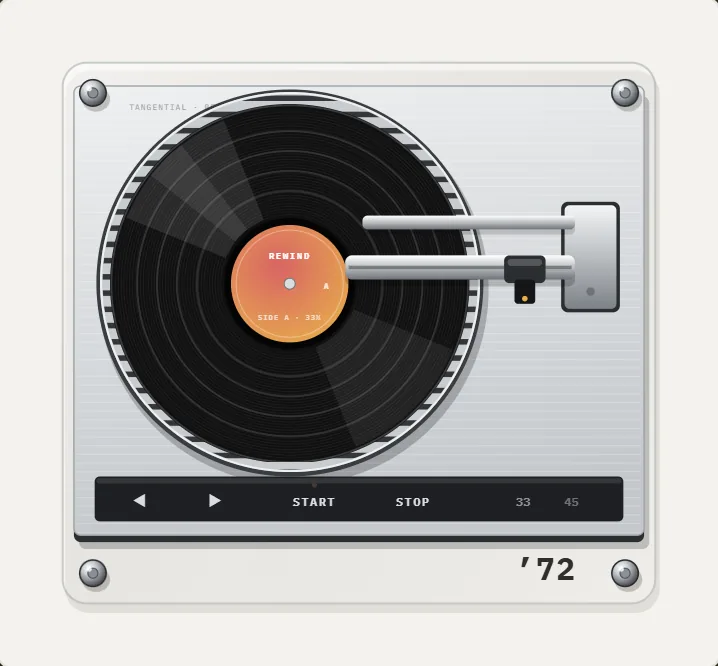 Turntable Speed33⅓ and 45 rpm in seconds per turn, how speed errors change pitch, three ways to check, and what an iPhone app can and cannot do.1968 Suitcase Record Player App for iPhoneOpen suitcase, cloth speaker lid, red leatherette deck, cream tonearm, speed lever. A PRO ’68 record player.Belt-Drive vs Direct-Drive TurntablesBelt or direct drive? How each turntable drive works, where each wins, and why DJs settled on the Technics SL-1200.Slowed and Reverb Any Song on iPhone, LiveWhat slowed and reverb is, where the style came from, and how to apply it live to your own music on iPhone.