REWIND
Spotify local files on iPhone, and a simpler way to play your own music
Spotify can play files you own on iPhone, but only after you enable local audio files in its settings, get the files onto the phone and find them in Your Library. If you just want to play your own MP3s and FLACs, a dedicated offline player needs no account, no subscription and no setup in a streaming app.
Download free on iPhoneSee all 30 machines
8 machines free forever · no account · works offline
Can Spotify play local files on iPhone?
Yes. Spotify's support page on local files says to open your profile, then Settings and privacy, then Apps and devices, and switch on "Local audio files". After that, your stored music appears in Local Files under Your Library. On iPhone you add tracks by copying them in the Files app into the Spotify folder under On My iPhone. The page also covers transfers from a Mac through iCloud or USB, and from Windows through iTunes or USB, and says you may need to allow access in your device settings.
Check the current page, because Spotify changes its apps and rules.
REWIND is an independent app and is not affiliated with or endorsed by Spotify. We mention Spotify only by name to describe what it does.
Why do Spotify local files often not work?
Spotify's support page suggests a few cures: make sure the app and device are up to date, remove local files from any playlists and repeat the setup, or reinstall the app. It also notes the Spotify folder can disappear from On My iPhone if its Help file is deleted, and that restarting the app brings it back. Beyond that, common causes are:
- The file is still in iCloud and not downloaded to the phone.
- The file type is not supported by Spotify, or it is DRM-protected.
- The setting is off after an update or a reinstall.
- The file was added on a different device and the phone has not received it.
- Crossfade behaves oddly: the support page says it works between local files only when they share the same sample rate and channel count.
What is a simpler alternative to Spotify local files?
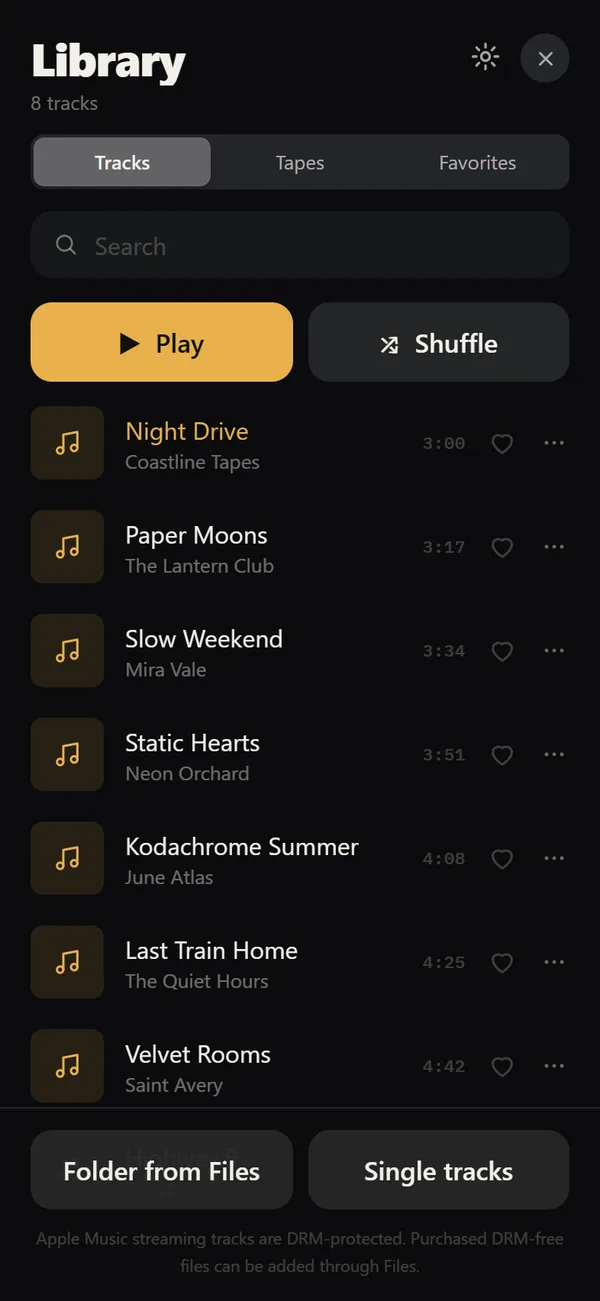
A dedicated offline player. You give it files and it plays them, with no streaming catalog and no login tied to the music you already own. Examples include Doppler, Flacbox, VLC and REWIND. We compare them in best offline music player apps for iPhone.
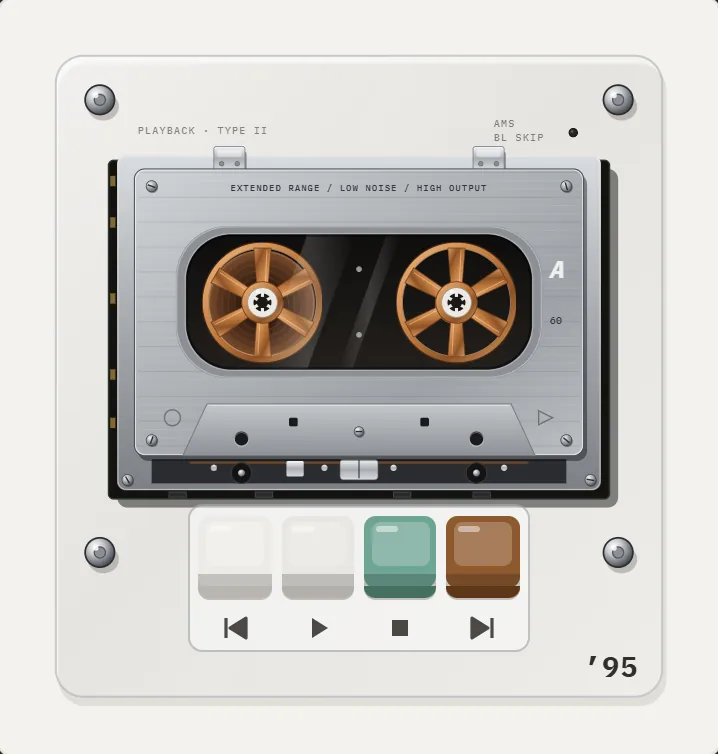
REWIND shows your files on retro machines. It has no account, shows no ads, collects no data and needs no connection. It cannot play Spotify or Apple Music downloads, only files you own. See the full offline music player page.
Spotify local files compared with a dedicated player
| Spotify local files | Dedicated offline player | |
|---|---|---|
| Account needed | Yes, a Spotify account | No |
| Setup | Enable a setting, then add files | Import from the Files app |
| Where files live | Your device and Spotify's Local Files section | Copied into the app |
| Streaming catalog | Yes, next to your files | Not included in REWIND |
| Works without internet | For files on the device | Yes |
| Formats | What Spotify supports | Depends on the app; REWIND takes MP3, AAC/M4A, ALAC, WAV, AIFF, FLAC, CAF |
| Best for | Mixing your files with streaming in one app | Keeping your own music separate and simple |
How do you leave Spotify for your own music, step by step?
The longer how-to is how to add music files to iPhone. If you need DRM-free songs, see where to buy DRM-free music.
- Gather the files. Use purchases, CD rips and Bandcamp downloads. Spotify tracks themselves are streams and cannot be exported.
- Put them in a folder on your computer and give it a clear name: artist, album.
- Copy the folder to iCloud Drive or send it to the phone with AirDrop. It appears in the Files app.
- Download any item that shows a cloud icon.
- Open the offline player and import the folder.
- Switch the phone to airplane mode and play a song to confirm everything is local.
- Build playlists or mixtapes inside the new app.
What can you not take with you?
Your Spotify playlists and downloads stay with Spotify. They are licenses to listen, not files. A third-party player cannot open them, and we do not recommend tools that claim to. If you want to keep a song, buy a copy from a store that sells downloads. For the technical reason, read DRM-protected music.
What about your Spotify library?
Moving to your own files does not mean leaving your streaming account. Plenty of people keep both: streaming for discovery, files for the albums that matter. A practical habit is to buy the albums you love as downloads, keep those in the offline player, and leave the rest of your listening to the service.
This also protects you from catalog changes. Streaming libraries lose songs when licensing changes, and a playlist can show grayed-out tracks one morning. Files you own do not do that. The only maintenance is a backup: keep a copy on your computer and one in cloud storage, and treat the phone as a viewer.
Which files can you bring from your computer?
| Source | Typically | Imports into REWIND? |
|---|---|---|
| CD rips | MP3, AAC, ALAC, FLAC, WAV | Yes |
| Bandcamp purchases | MP3, FLAC, AAC, ALAC, WAV | Yes |
| iTunes Store purchases (DRM-free) | AAC | Yes |
| Old protected iTunes files (.m4p) | Protected AAC | No |
| Spotify or Apple Music downloads | Protected | No |
| OGG, Opus, DSD, APE, WMA files | Other formats | No |
What are the downsides of leaving the streaming app?
Those costs are the reason many people keep both. If your main need is a quiet place for the albums you own, the offline route is enough.
- You lose recommendations and the catalog. A player shows only what you own.
- Playlists do not carry over. You rebuild them from your files.
- You need to manage backups. Nobody syncs the library for you.
- Lyrics and credits depend on the tags in your files. REWIND shows title, artist and cover art from the tags, not lyrics.
- Storage becomes your problem. Lossless files are large.
Is a separate player worth it?
It is for people who want music that does not move when a subscription changes, who want a quiet player without recommendations, or who simply like the look of tape and vinyl. REWIND adds a tactile layer: analog sound, an equalizer and mixtapes with handwritten labels. 8 machines and one mixtape stay free, and the PRO plans are $2.99 weekly, $19.99 yearly with a 3-day trial, or $24.99 once.
Keep Spotify for discovery. Keep your own files where a catalog change cannot touch them.
Frequently asked questions
How do I play local files on Spotify on iPhone?
Turn on Local audio files in Spotify's Apps and devices settings, copy the files into the Spotify folder under On My iPhone in the Files app, and open Local Files in Your Library.
Why are my Spotify local files not showing up?
Check the setting, download iCloud files, confirm the format, and repeat the setup. Spotify's support page also suggests removing local files from playlists and reinstalling.
Is there a Spotify alternative for my own MP3 files?
Yes. Offline players such as Doppler, Flacbox, VLC and REWIND play files you own with no streaming account.
Can REWIND play my Spotify downloads?
No. Spotify downloads are DRM-protected. REWIND plays files you own, such as MP3 or FLAC.
Does REWIND need an account?
No. REWIND has no account, no ads and no analytics, and it works offline.
Keep exploring
 Offline Music Player for iPhone, No AccountNo network, no account, no ads, no tracking. Your files stay on the iPhone.How to Add Music Files to iPhone Without iTunesFour ways to get MP3, FLAC and M4A files onto an iPhone, and how to import a whole folder into a player.Where to Buy DRM-Free MusicWhere to get music as files you own: Bandcamp, iTunes, Qobuz, Amazon, Beatport and CD rips, plus how to check a file is DRM-free.DRM-Protected MusicWhy streaming downloads cannot be imported, and which DRM-free sources work.Best Offline Music Player Apps for iPhoneTen offline music player apps for iPhone compared on price, formats and App Store ratings, October 2026, with honest limits for each.REWIND vs Apple Music AppApple Music streams a subscription catalog. REWIND plays your own files on retro machines. Different jobs, often used together.