REWIND
Why old music sounds warm, and what is really going on
Old recordings sound warm because analog gear adds gentle harmonic distortion, softens the highest frequencies and varies speed slightly. Tape saturation, vinyl's physical limits and tube circuits all contribute. Warm is a listener's word, not a measurement, so the effect is part physics and part taste.
Download free on iPhoneSee all 30 machines
8 machines free forever · no account · works offline
What does warm sound mean?
Warm usually means a fuller low-mid range and a softer, less glassy treble. People also use it for smooth, rounded, close and easy to listen to. None of those terms is a unit of measurement. Engineers talk about frequency response, distortion and noise instead, and the question is which of those analog media change.
Three physical effects explain most of the picture: harmonic distortion that adds overtones, a gentle roll-off at the top of the spectrum, and small speed variations. The ear then does its part, which we get to in the section on the ear.
How does tape make music sound warm?
Magnetic tape is not a linear medium. Its magnetic characteristics follow a hysteresis curve, and recording a raw signal on it would distort badly. Engineers add an inaudible high-frequency bias to push the signal into the usable range, as the magnetic tape recording article explains. Even so, loud passages push the tape toward saturation, where peaks are rounded off and the signal gains extra harmonics. We cover that in what is tape saturation.
Tape also adds hiss, from the grain of the magnetic coating. It has wow and flutter, which are slow and fast speed variations. Listeners find flutter most objectionable around 4 Hz, according to the wow and flutter measurement article, though slight wobble can read as a living, chorused quality rather than a flaw. Cassettes add one more factor: a narrow 3.81 mm strip at 4.76 cm/s typically cannot carry as much treble as a studio reel, so the top end is softer.
What about vinyl, tubes and old speakers?
Vinyl has its own limits. The stylus reads the groove mechanically, and groove geometry, cutting limits and inner-groove speed all shape what ends up on the disc. Surface noise and crackle sit on top. We explain the noise in why vinyl crackles. The format also invites a ritual: you flip a side, so you listen to a whole side.
Tube amplifiers add a third ingredient. The tube sound article says the tube sound is often described as having warmth and richness, but the cause is not agreed. Candidates include non-linear clipping and higher second-order harmonic distortion. The audible importance of tubes remains a matter of debate among enthusiasts, so treat anyone who says it is settled with some caution.
Why does the ear matter?
The ear does not hear all frequencies equally. Harvey Fletcher and Wilden Munson measured this in 1933, and later work refined it into the equal-loudness contours standardized in ISO 226 (revised in 2003). The equal-loudness contour article summarizes it. At low volume the ear loses sensitivity to bass faster than to the mid-range, so a recording played quietly sounds thinner than the same one played loud.
That matters for the warm question in two ways. A mix that sounds balanced at a high level can sound weak in a quiet room, so listeners may reach for bass and warmth. And an analog chain that tilts the balance toward the low mids may compensate for what the ear is missing. Neither effect requires nostalgia.
Is digital audio cold?
The CD format samples at 44.1 kHz with 16 bits, which covers the full audible band with a very low noise floor. A 128 kbit/s MP3 is about 11 times smaller than that and drops detail the encoder judges you will not miss. Clean is not cold by definition. Clinical is a judgment about taste, and a lot of modern recording is also loud and heavily compressed, which can make music tiring in any format.
| Analog chain | CD or high-bitrate file | |
|---|---|---|
| Distortion | Gentle harmonics from tape, vinyl, tubes | Very low in the format itself |
| High frequencies | Rolled off by the medium | Full 20 Hz to 20 kHz range at 44.1 kHz |
| Noise | Hiss, crackle, hum | Low noise floor, 16-bit |
| Speed | Wow and flutter | Crystal-clock steady |
| Sound | Often called warm | Often called clean or clinical |
Is warm sound better, or just different?
Different. Whether people prefer the added distortion depends on the listener and the material. Rock vocals and drums may benefit from tape saturation, while a solo piano may not. If you want to read controlled experiments instead of opinions, the Audio Engineering Society keeps its papers in the AES E-Library.
What you should avoid is the idea that warm equals accurate. By definition, adding harmonics moves the sound away from the source. It can be lovely, and it is a choice.
How can you get a warm sound on your iPhone?
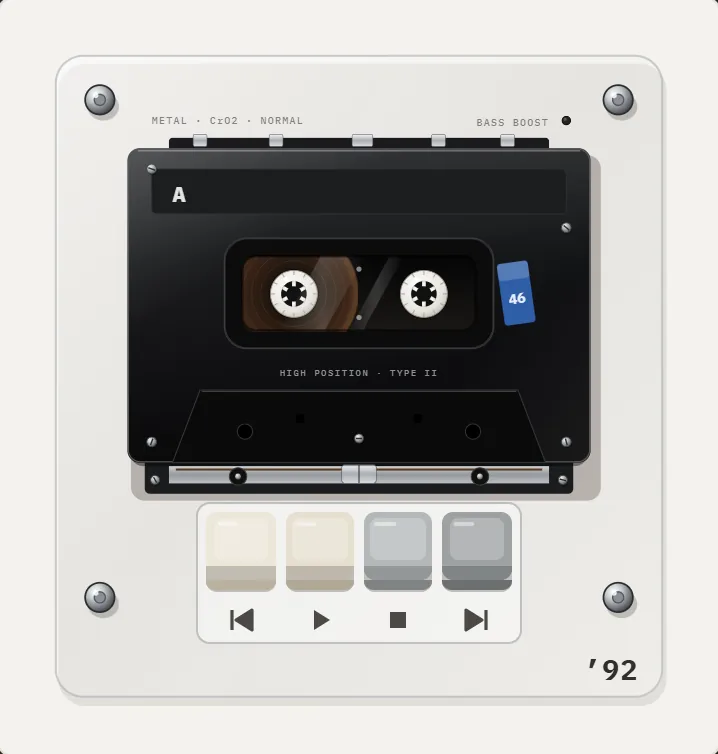
REWIND builds the common ingredients into two switches. Analog sound adds tape saturation, wobble (wow and flutter), hiss and vinyl crackle, each with its own slider, and everything is computed on your phone in real time. Machine sound gives each machine its own warm profile automatically. A five-band equalizer centered at 60 Hz, 250 Hz, 1 kHz, 3.5 kHz and 12 kHz has a Warm preset beside Flat, Bass, Vocal and Air. Start with the analog sound feature, then the equalizer. For a tape view of the same subject, see the 1992 pocket cassette machine.
Frequently asked questions
Why does vinyl sound warmer than digital?
Vinyl adds surface noise and has physical limits at the top and bottom of the spectrum. It also rounds peaks. Many listeners describe the result as warm, though it is a matter of taste.
What is tape saturation?
Tape saturation happens when a loud signal pushes magnetic tape toward its limit. Peaks are rounded and extra harmonics appear, which acts like soft compression.
Is analog sound more accurate than digital?
No. Analog media add distortion, noise and speed variation. Digital formats like CD reproduce the signal more precisely. Analog can still sound more pleasant to some listeners.
Why does music sound thinner at low volume?
The ear is less sensitive to bass and treble at low levels, as shown by the Fletcher and Munson equal-loudness measurements of 1933 and the later ISO 226 standard.
How do I add a warm sound in REWIND?
Turn on the Analog sound switch and adjust saturation, wobble, hiss and crackle. You can also choose the Warm preset in the five-band equalizer.
Keep exploring
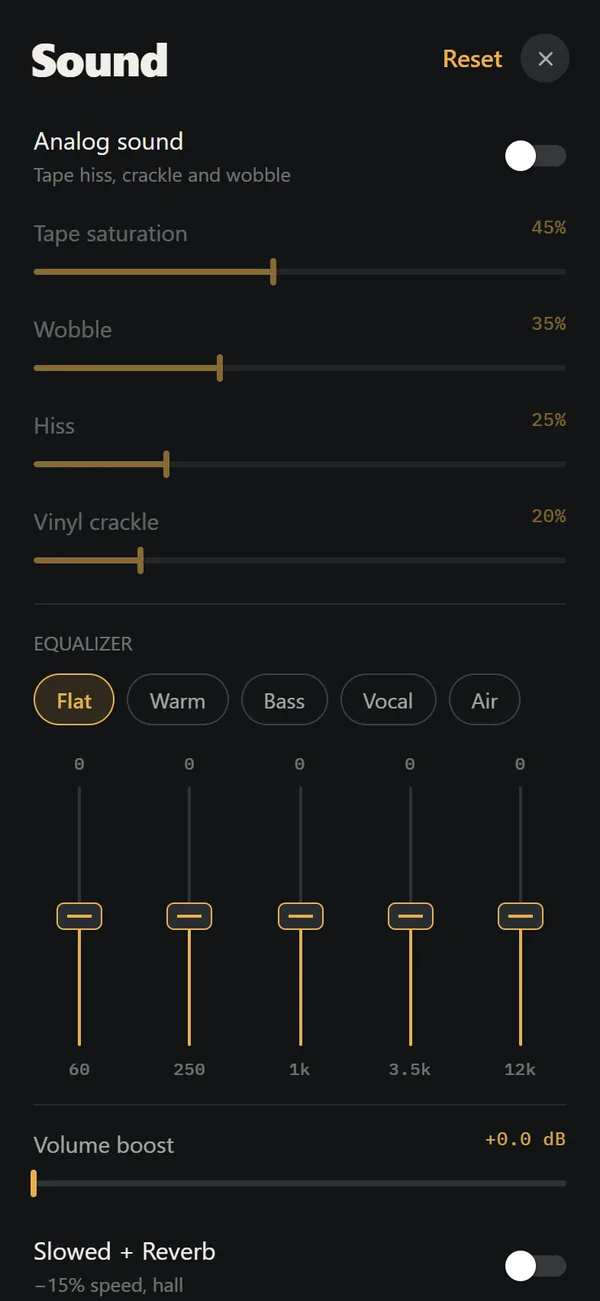 Analog Sound on iPhoneFour sliders (saturation, wobble, hiss, crackle), automatic machine sound and a lo-fi radio filter, live on your own files. Free.5-Band Equalizer for iPhone Music Files, FreeFive bands (60 Hz to 12 kHz) and five presets, applied in real time to your own files. Free.
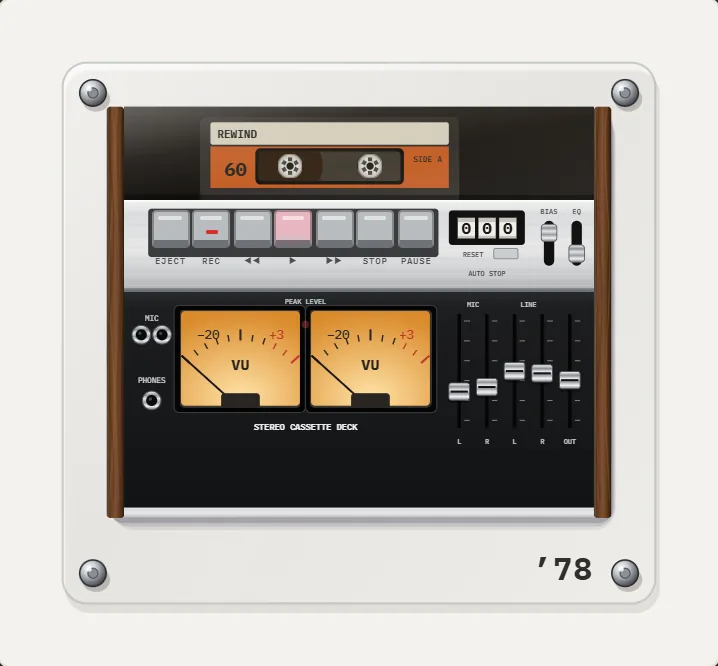 What Is Tape Saturation? The Sound of Magnetic TapeThe physics of tape saturation, why bias exists, what harmonics it adds, and how to set a tasteful amount.
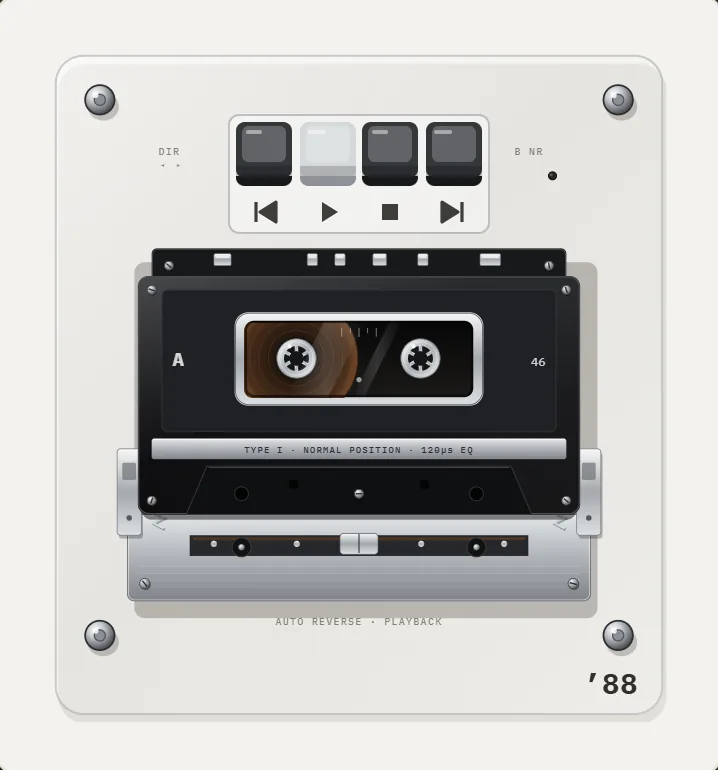 What Is Wow and Flutter? Tape and Vinyl Pitch DriftWhat causes wow and flutter, how it is measured in percent, and how to add a gentle amount back to digital music.
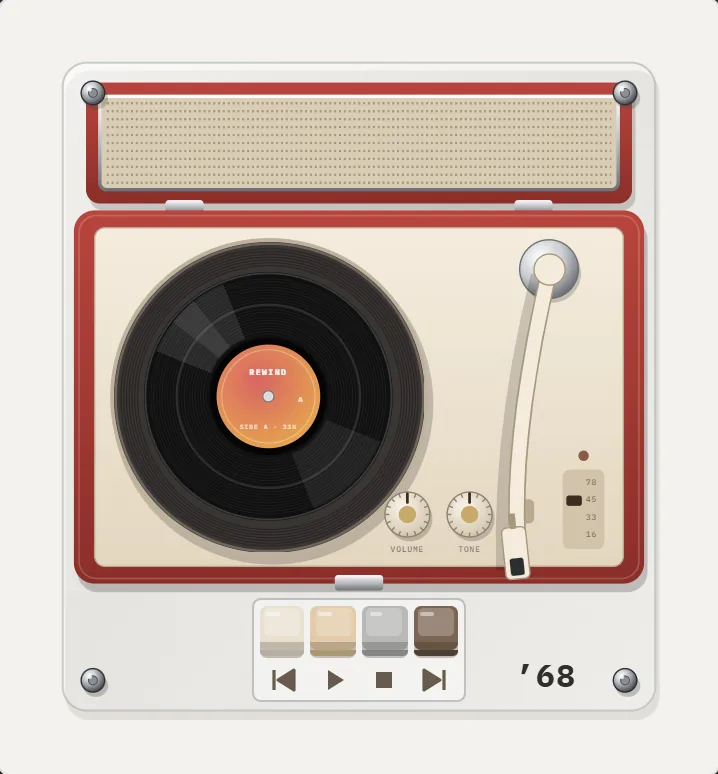 Why Vinyl CracklesThe physical reasons vinyl crackles, how a stylus reads a groove, and how to add or avoid the sound.1992 Glossy Black Cassette PlayerGlossy black cassette, large white toothed hubs, chrome tape path. A PRO ’92 machine.